



Paul Symington: how failure to consult Douro farmers has fuelled crisis
Former chairman of leading Port producer Symington Family Estates, Paul Symington warns that the state’s failure to consult producers and balance supply and demand has deepened a systemic crisis in the Douro.
Paul first drew attention to his concerns in an article published in Portugal’s main national newspaper Publico, and we have, with his permission, reproduced an English translation of that piece, which you can read in full below.
Crisis in the Douro
The Douro is facing one of the most challenging times in its long history, but the public debate has largely ignored the real reasons behind the crisis. The situation has been made worse by the failure of successive governments to modernise the antiquated regulatory system of the Douro Demarcated Region (RDD), with serious consequences for the region’s farmers and companies, and for the image of the region’s wines.
The best European Demarcated Wine Regions are carefully managed to protect value and promote economic sustainability. The two golden rules have been to improve wine quality and, simultaneously, avoid overproduction. Champagne is perhaps the most successful example of all.
The Douro was the world’s first demarcated wine region in 1756, and remains today one of the most heavily regulated, under the supervision of the Instituto dos Vinhos do Douro e Porto (IVDP), which is a department of the Ministério de Agricultura e Pescas. The powers of the state in the RDD are unique, as most other Portuguese wine regions are managed by Comissões Vitivinícolas Regionais (CVR), which are largely self-regulating.
The Douro has an Interprofessional Council (farmers and companies equally represented), but the president of the IVDP holds the deciding vote. The nomination of the IVDP president is almost always political, and only rarely is a person chosen with experience in the world of wine, which should be a fundamental requirement.
Given the enormous responsibilities of the IVDP, which despite being a department of the Ministry of Agriculture is entirely funded by the RDD (with the Port and wine companies responsible for more than 90% of IVDP income arising from a special tax paid on every bottle sold), it would be expected that the IVDP would analyse the wine trends that impact the RDD, especially in view of the almost total dependency of the region’s population on wine.
In normal circumstances, the state should be consulting the RDD’s farmers and companies on future production and sales expectations and adapt the region accordingly, with a view to balancing supply and demand for the well-being of the region. This did not happen.
World-wide trends
Historically, the Douro has been almost entirely dependent on the sale of large volumes of Port. But due to the worldwide reduction in consumption of fortified wines, the Douro has seen a decline in Port sales volumes, and this has occurred at the same time as the extraordinarily high cost of producing wine in the world’s largest area of steep mountain vineyard has become ever more evident.
Port has declined much less than all other fortified wines, but even so has reduced by 34% in volume and 46% in value (adjusted for inflation) since 2000. It is likely that by 2030, Port volumes will have dropped by 40% since 2000. Considering that the amount of Port produced in the region each year is adjusted by the IVDP according to total stocks and sales, it was obvious that the amount of Port produced (known as ‘beneficio’) would be reducing each year, with serious consequences for the Douro and its farmers.
Port has not suffered as badly as other fortified wines due to the considerable investment and innovation undertaken by some Port companies, following the exit from the sector of many other companies who preferred an easier life, together with the departure of various multinational groups who did not appreciate such low margins. The sales of premium Ports have remained strong, to the envy of all other fortified wines.
Despite these negative trends and the multiple appeals made to the authorities for better management of the RDD, virtually nothing has been done, and the results are now evident. Few wished to speak out publicly about what was happening in the Douro or alert the farmers and regional political leaders. It was obvious that the sector was getting weaker, and since Port was always the ‘economic engine’ that sustained the economy of the Douro and its people, it should have been clear that urgent measures were needed.
Today, there are a few companies dedicated primarily to Port. In the future, there will be less.
The special characteristics of the Douro
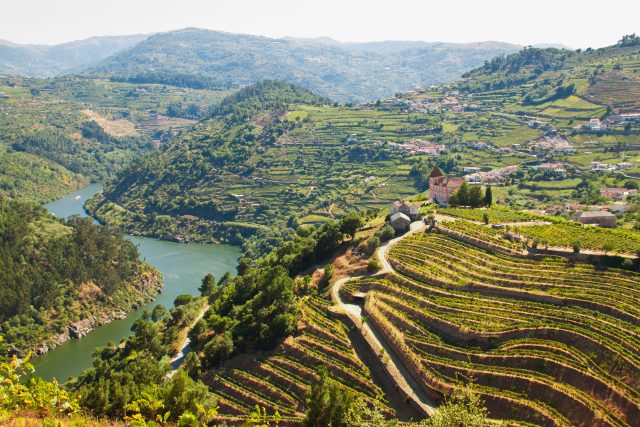
With an impressive 50% of the entire world’s mountain vineyard, the Douro’s productivity per hectare is by far the lowest of all the world’s main wine regions. This is the result of the natural condition of the Douro’s very specific soils and climate, and the very high costs of growing grapes on such steep mountainsides. This reality was hidden for generations by the easy availability of cheap labour. But since Portugal joined the European Union in 1986, cheap agricultural labour has disappeared, and the Douro’s population has declined by nearly 30% over the last 40 years.
It appears that few in authority analysed the Douro’s yields and costs compared to the rest of the world to better understand the inevitable consequences on the economic and social future of the region. The major UTAD (University of Vila Real) study of 2018 highlighted many of these facts, but this important document has been largely ignored.
The reality is that never again could the Douro be a region of large production of cheap wines for the world, and it had become urgent to adapt the region to smaller volumes and greater value, to protect the Denomination of Origin and increase the income of the farmers and the entire sector.
Douro DOC Wines
Over the last 40 years, the sales of Douro DOC wines have increased exponentially, reaching over 60 million bottles in 2024. These wines now account for over half of the region’s grapes and are a great asset for the Douro and for Portugal.
But the authorities, and many journalists, continue to see Douro DOC wines merely as a by-product of the region, with little relevance in sustaining the economy of the Douro and its farmers. Apparently, only Port has the ‘responsibility’ of sustaining the regional economy, despite losing 34% of its sales since 2000, and now using less than half of the Douro’s grapes.
The grapes for Douro DOC wines are the same as those used for Port, and of course, cost the same to produce. But because the ‘Beneficio’ system for Port limits how much Port can be made each year, and because of a systemic excess of grapes in the region, the price paid for Douro DOC grapes is between 50% and 70% below the prices paid for Port grapes, and far below the cost of producing them.
Partner Content
The average sales price for Douro DOC wines, according to official IVDP data, is only 12% below the average Port selling price (Douro DOC wines are not obliged to hold substantial reserve stocks, as all Port producers are legally required to do). It is not difficult to see which is the most profitable business today.
The cost of grapes in the Douro
The direct cost of producing grapes in the Douro is about €0.95/kg, naturally varying somewhat each year. The total cost, including depreciation of vineyard and farm equipment, is over €1.50/kg. The prices paid for Port grapes (due to the Beneficio limit) are above the direct costs, despite the market declining 34% over the last 24 years. The prices paid for Douro DOC grapes are between 30% and 60% below the direct cost of producing them, the result of the free market for Douro DOC grapes and the endemic excess in the region. It is obvious that the Douro is in an unsustainable situation.
Some have called attention to the danger of having two great wines being produced in the same region with very different rules: one under free market conditions (Douro DOC) and the other (Port) subject to an annual limit that is used to protect farmers’ income. It was obvious that things would go very wrong.
Farmers face almost impossible competition
Under the present regulations, a young farmer who opts to launch their own wines onto the market will obviously be faced with the real cost of producing the grapes (approx. €0.95/kg).
But when this farmer takes their wines to the market, they are frequently confronted with wines from their own region, duly certified, from an operator who has no vineyard, and who has simply purchased grapes on the open market (at between €0.50 and €0.70/kg) and consequently can offer Douro wines at vastly lower prices. The young farmer’s project is fatally undermined, but sadly, it appears that few are concerned about this glaring injustice that is the direct result of an outdated and ill-adapted regulatory system.
The image of Douro wines
Many prefer to ignore the real damage being done to Douro DOC wines in international markets through the sale of large volumes of wine at low prices, the result of too many grapes being sold at €0.50/kg (about half the cost of producing them). These prices are only possible while farmers receive, for the moment, much higher prices for their Port grapes.
In the coming years, due to the abandonment of vineyards through lack of economic sustainability, the Douro’s grapes must ultimately be transacted at the very least at cost price. The consumer, used to buying Douro wines at the same price as some of the cheapest wines in the world, will naturally buy less. In the meantime, the image of Douro wines will have been seriously damaged.
The Douro’s wines should reflect the reality of their origin: a region of rare beauty, of steep mountain vineyards, of incredibly low yields, of high costs, but of wines of great quality. Never of cheap wines.
Brandy from the Douro
One of the proposals for resolving the endemic excess in the Douro is to distil the unsold grapes and use the resulting brandy for the making of Port. This appears to be an attractive and easy solution, but it brings huge risks as the brandy produced in the Douro will cost 4 to 5 times more than brandy available on the market. Such a cost increase will obviously push up the price of Port to the consumer, with the inevitable result of reducing sales, which will further reduce Port grape purchases from Douro farmers in the coming years.
Conclusions
The lack of attention by the authorities with responsibility for planning and management of the RDD to the long-term changes in consumer consumption habits, and the refusal to heed the multiple appeals for change, especially from the Associação das Empresas de Vinho do Porto (The Association of Port Wine and Douro Producers), has worsened the crisis that now assails the region.
Regrettably, many commentators in the public debate on the Douro continue to show an extraordinary lack of understanding of the easily available data and ignore the reality of what is happening to wine across the world. Some even appear keen to aggravate tension between farmers and companies, only worsening the situation.
It is essential to see what is happening in the major French, Italian and Spanish wine regions, and more widely in the new world, and understand the measures which are being applied to ensure the continuity and prosperity of their wine regions. The Douro cannot be the only wine region in the world where nothing changes.
It is unarguable that with 43,000 hectares, the Douro has too much vineyard considering the very specific conditions and costs of producing grapes in these steep mountain vineyards, and in view of current and forecasted sales. The endemic excess of grapes in the Douro has left farmers with little negotiating power, and the solution can only be a reduction in the total vineyard area, exactly as is happening in France and other of the world wine regions.
Vineyard abandonment is already happening in the Douro due to lack of profitability, and sadly, this process will accelerate until an approximate balance is achieved between supply and demand.
A compensation scheme for farmers is needed – entirely voluntary – for those who opt to abandon their vineyards. The French are doing exactly this to enhance their Wine Denominations and to protect their farmers’ incomes. Simultaneously, a Douro farmer should be able to reduce their vineyard area without losing part of their Port licence allocation (‘Beneficio’), thereby reducing their own costs and at the same time reducing the region’s excess grapes.
The IVDP must be modernised or substituted by a Comissão Vitivinícola Regional. A new management model is required for the RDD, which is more professional and efficient, and which takes into account the reality of the Douro and international markets. A new strategy is needed which adds value to the region’s grapes and wines and avoids the huge excess of grapes, which is so damaging to the regional economy.
It is hoped that the Minister of Agriculture uses the knowledge of the farmers and companies to create a plan that addresses the crises in the Douro and puts the region on a more sustainable basis.
The quality of the region’s Ports and Douro DOC wines are beyond question, and both have even greater potential and will continue to affirm their place amongst the world’s greatest wines, but only if the region is better adapted to the real world.
- The above article is a translation of a piece published by Publico on 29-8-2025 by Paul Symington.
Related news
Canada wine ban wipes US$357m from US exports
Why failing to stock a non-alcoholic cider is ‘a missed opportunity’


