



The Big Interview: Sebastián Labbé
Santa Rita head winemaker Sebastián Labbé is as enthusiastic as ever about his job – especially when it comes to the icon that is Casa Real. Arabella Mileham reports.
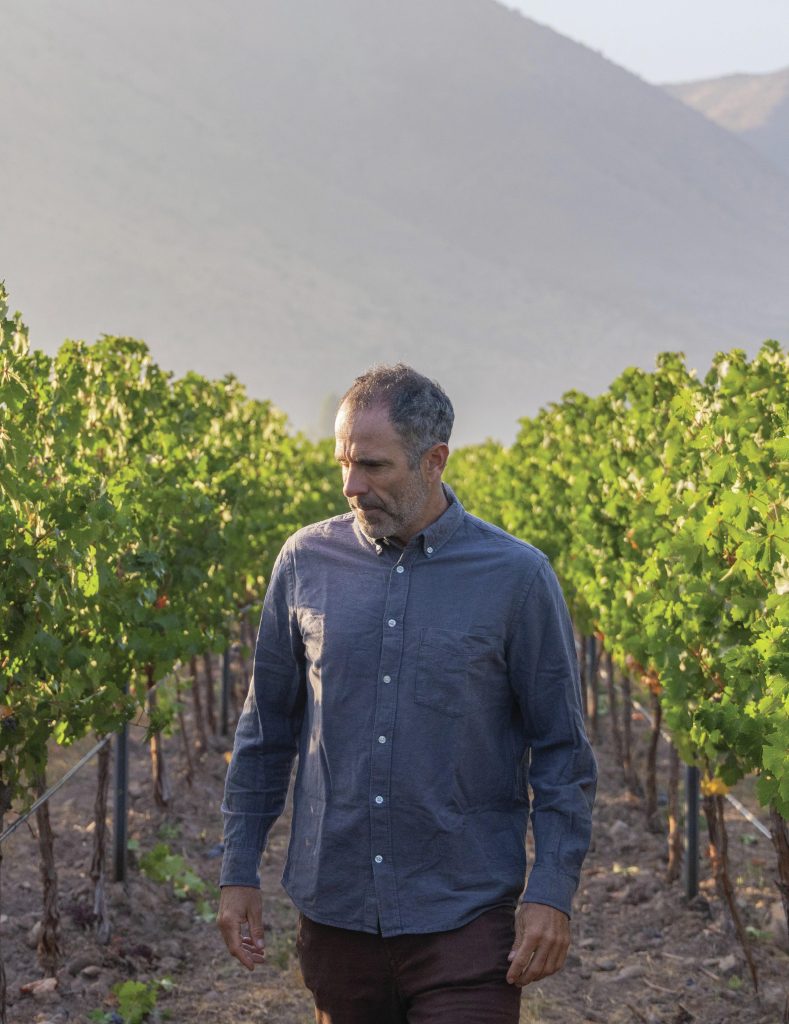
From jumping into a soil pit to explain the physical differences between different sites on the Santa Rita and Carmen estates, to discussing the evolution of the producer’s icon wine Casa Real over the last 20 years, Sebastián Labbé’s enthusiasm is infectious.
He has previously described the role of winemaker at Viña Santa Rita as “a fantastic and magical job”, and he is clearly as enamoured of it now as he was when he started out in the world of wine, gaining experience travelling and working in New Zealand and Australia. Labbé joined Santa Rita Estates in 2005, first as winemaker at Viña Carmen, and later, in 2017, he took the lead at Santa Rita as winemaker for Casa Real, capturing the terroir of Alto Jahuel in Chile’s Maipo Valley.
While he respects the classic style of the past, under his care the wines have evolved with greater precision and consistency, as db learnt when we sat down with him for a masterclass, tasting and tour of the estate during July.
Santa Rita lies in Alto Jahuel on the south bank of the Maipo river, rising from around 550 metres above sea level. The heart of the vineyards lies around four kilometres from the river, which gives its position a different concentration of clay and organic matter over the underlying rocks from other areas in Maipo.
“It gives us a unique signature,” Labbé notes, “a particular style that has to do with the climate, with the soils – which are similar alluvial deposits, gravelly soils, but probably with a little bit more clay in the topsoil.”
As a result, the wines “have a completely different feeling”, he explains. “Those old gravelly soil formations have some unique characteristics in terms of the great amount of stones covering the profile, limiting vigour but with different deposits and in situ formations that have different concentrations of clay and organic matter.”
Historic winery
Viña Santa Rita, founded in 1880, is one of Chile’s historic wineries. Its Casa Real wine was the brainchild of its later owner, Ricardo Claro, a fan of wines from the Médoc, who challenged the Chilean winemaking team to create a wine that could stand among the world’s greats.
The first milestone came in 1987, long before Maipo became renowned for its wines, when a bottle of Medalla Real Cabernet Sauvignon 1984 won the gold medal in the ‘Olympics of Paris’.
“That confirmed that we were pretty much the ambitious project that Ricardo had in mind,” Labbé explains. “You could taste it – there was something super quality there in the glass.”
Finally, in 1989, the first vintage of Casa Real was born, becoming the only Chilean icon wine that has been entirely dedicated to Cabernet Sauvignon since its inception. It became clear which sector of the vineyard was consistently producing the best Cabernet – and this was how the parcels came to be selected. Today the area is still restricted to around 20 hectares, and the oldest part (Carneros Viejo) was planted in 1970, with another (Población) planted 10 years later. Both use a massal selection of ungrafted vines. In this way, these two sectors, together with eight blocks and 25 micro-lots in Alto Jahuel, represent one of the finest terroirs for Cabernet Sauvignon in Chile.
“There is enough complexity within those vineyards with the intra-parcel definition we have done over time to get the full potential of each particular block and the best attributes to build the finished wine,” Labbé says.
That style – aligned with the concept of a grand vin: structured, elegant and with great ageing potential – is what defines Casa Real. “Over time, it has become the purest expression of Cabernet Sauvignon,” adds Labbé.
Best results
The majority of parcels are a combination of own-rooted and massal selections – which Labbé says has given the best results. However, there are also some blocks planted between 2015 and 2021 with clones (“we’ve been working strongly with 169, 170, 385 and a little bit of 412,” he explains) and rootstocks such as 110R (“very well-adapted to drought, but sensitive to water excess”) and 1103 Paulsen (“moderate to high-vigour rootstock, with excellent drought tolerance”) among smaller trial blocks.

“They might be part of the final blend – we still don’t know,” Labbé smiles. “I don’t have a crystal ball to see the future – sometimes I wish we had. But one thing that we cannot buy in this case is time – and there are no shortcuts in winemaking. We need to go through step by step and year by year. And I always say that, in this job, we only have one shot a year. That is what makes it very difficult.”
Labbé has been working with Jean-Philippe Roby, an associate professor, teacher and researcher at Bordeaux Sciences Agro and ISVV (Vine and Wine Scientific Institute of Bordeaux) on the replanting and vineyard management, and with the legendary Eric Boissenot on vinification and blending (“we used to work with his father, Jacques”). Over that time, the wines have increased in precision, finesse and elegance, partly due to the greater focus on intra-parcel selections and more precise harvesting, relying not only on tasting, but also on a broad range of technical information to back up the decision-making process.
Finding balance
Labbé also touches on the challenges of finding the right balance in the vineyard. “One of the problems we have here in the Maipo Valley is that we have natural concentration in the vines, and we have small bunches and berries because of all these massal selections,” he explains. Finding an equilibrium between the tannin and the fruit is therefore key, he argues – and this comes not only through vineyard management, but also through a “super-infusive style of extraction” during fermentation. “It is more intensive at the beginning and medium part of the fermentation, and extremely gentle towards the end,” Labbé notes. “This is because the pressed wine is super-important to us.”
According to Labbé, “this is one of the benefits of working with Eric Boissenot – it has completely changed our perceptions around how the pressed wines could be used”.
Around 8%–9% of pressed wine is now included in the final blends, which Labbé argues is quite “Bordelais in approach”, compared to the New World style being built around free-run juice and guided by the aromatic profile. “The main ambition there is to try to have a Cabernet that has the concentration, the texture, the grip and the structure, but which is easier to approach at a younger stage,” Labbé explains. “I think nowadays, when we launch wines into the market, they need to be ready to drink, but also have the double function to have two or three decades ahead of them in terms of ageing.”
And, to prove his point, he pours a glass of the 2005 vintage of Casa Real alongside the 2022 and 2023 vintages, a wine that has aged in a “beautiful way”. “It is very nice to see how the fruit is slightly riper, with more spices and secondary characters being developed in the bottle, but it is still what I like – the tannin texture and the freshness,” Labbé says.
Gradual evolution
Although Labbé admits that the style of the house is very well defined and will always remain classical, “we have other ranges of wines where we can innovate and take different approaches.” There have, however, been some tweaks to Casa Real over time, he says.
“For example, the temperature of the fermentation has been lowered (from around 28o C in the 2000s to around 24o C now), which helps impart more freshness, while the use of oak has also diminished over time.
“I think we make the wine slightly fresher and more vibrant nowadays, but the 2005 is a wine worth giving a go after two decades.”
These tweaks are about working out which direction you want to go in, Labbé argues. “It is not that we are changing,” he emphasises. “We are just fine-tuning things. The wines are made pretty much as they were 20 years ago, but we have got much more technology, more experience in terms of how to separate different things. So a block that used to be picked all at once in 2005 might now be picked three or four times, and we have smaller tanks to make that possible.”
La Place de Bordeaux
Since 2021, Casa Real has been distributed via La Place de Bordeaux, making it one of the first five Chilean wines to join this global network for fine wine distribution.
Looking ahead to this year’s Casa Real release on La Place, the 2022 vintage is something of a surprise, coming as it does on the back of the “great” and “complex” 2021 vintage. Consequently, the market perhaps isn’t expecting the 2022 release to be as good.
“The 2021 for me is a fantastic wine – it has concentration, it has structure, it is very fresh – but I think there is a little bit more precision in 2022,” Labbé explains. As a result, he is convinced that it will prove any doubters wrong. “Although it is a wine that is probably less explosive and exuberant, it is much more delicate and precise. And I think that is what wine connoisseurs really value in these types of wines,” he says.
Casa Real 2022 was the result of a cooler growing season, which produced lower yields compared to the more “classical” nature of 2021, which was warmer in style, although 50mm of rain in January helped it retain its “unique characteristics”.
Which vintage does Labbé prefer? “Cooler vintages are interesting on first impression, but when tasting the wines with a little bit of time, I would say that younger, hot and dry vintages like 2020 for me really prove to us that a great terroir is able to over-perform in challenging vintages,” he responds.
This, Labbé explains, is due to a combination of the influence of the Andes Mountains, and the soil and climate with its high diurnal range (of around 20o C), which provides a “buffer” for the hotter vintages, so that the wines retain a vibrancy and freshness.
Call for regulation
Several years ago, Labbé argued that Chile needed stricter regulations to help it improve the quality of its wines, but he seems to be more languid these days. “I think things have improved,” he muses. “But most of that improvement has been through there being more talking between producers in terms of what we expect of a Cabernet from different sites. You see winemakers getting together much more often, sharing the way they do things, their farming technologies and approaches, and also what they do in the winery.” Labbé is still hopeful that, at some stage, there will be a DO for Alto Jahuel, not only defining the geographical location, but also the quality requirements of its wines.
“I love the freedom that we have in the New World, but what happens if someone makes a Cabernet from Puente Alto that is only average quality?” he asks. “We need to maintain a certain level just to keep the quality high.”
Related news
Brazilian demand gives Chilean wine a winter boost


