



Tempranillo to Tinta del País: Bodegas Roda and La Horra (Part II)
Bodegas Roda was attracted to Ribera del Duero by a different expression of its signature grape variety, Tempranillo, but the company’s core philosophy remains constant – extending to La Horra’s new winery, claimed to be one of the most sustainable in Europe. Richard Woodard takes a look around.

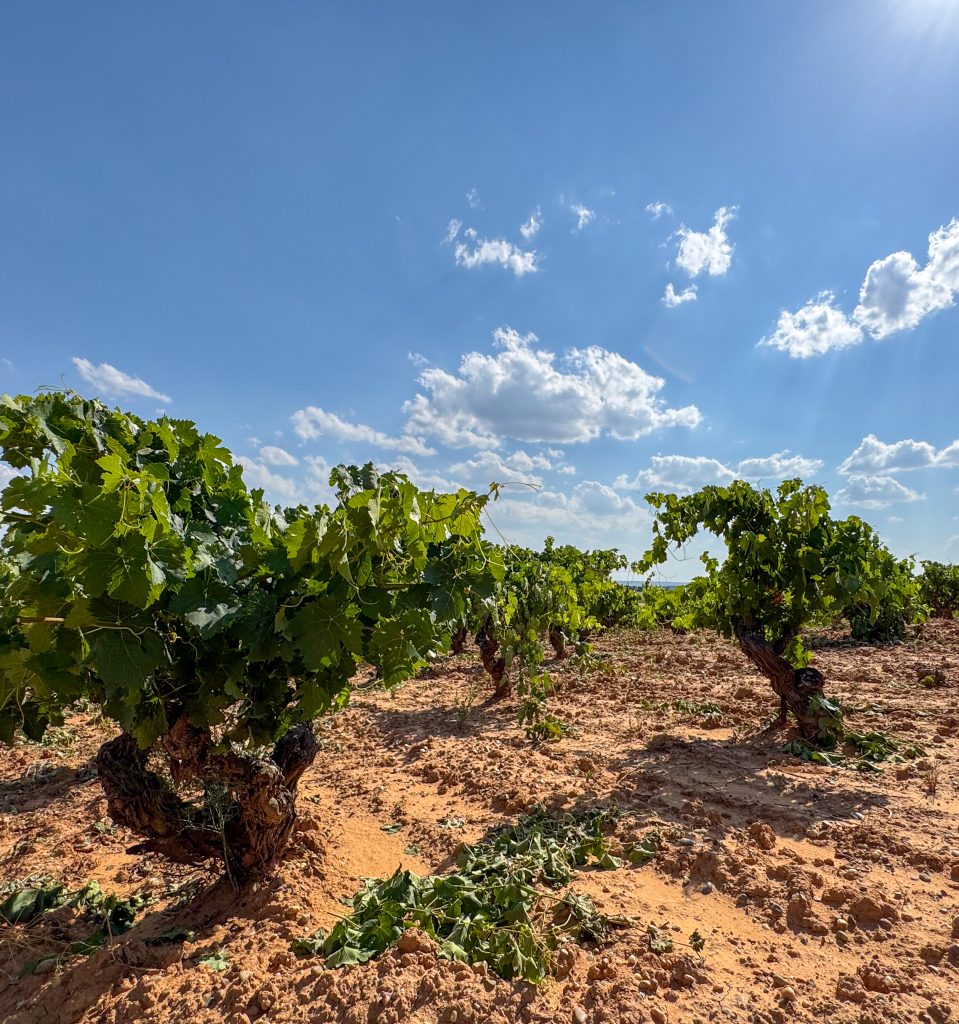
“We love Tempranillo,” says Vicky Bocanegra, area sales manager at Bodegas Roda and La Horra, gazing out over a sprawl of 70-year-old bush vines, their gnarled, contorted trunks supporting long sprays of canopy shading still green grapes. “We think it evolves and ages perfectly wonderfully … We want to go where Tempranillo lives to develop very good wines.”
We’re standing on a patch of compacted earth and builders’ rubble, on a low elevation overlooking the broad, shallow valley of the Duero – unrecognisable as the same river that slices through Port’s vertiginous vineyards a few hundred kilometres to the west. At our backs sits Bodegas La Horra’s new winery, a low-lying, deliberately discreet wedge of concrete, brick and glass.
Bodegas Roda established La Horra in 2009, a culmination of the Rioja-based producer’s quest to find Tempranillo excellence outside its home region. After trying other locations, including blind tastings and expeditions to Toro (too hot) and Arlanza (too cold), Ribera del Duero – and La Horra in particular – hit the Goldilocks spot.
In Ribera del Duero’s continental climate – hot summers, cold winters, risk of spring frosts – Tempranillo has morphed into Tinta del País, a name change that is more than a local conceit. Huge diurnal variations in temperature – the mercury can surge from 6-8C at breakfast to 24-26C by lunch at harvest time – have produced a thicker-skinned, smaller-berried grape packed with anthocyanin and tannin.
One of the keystones of Bodegas Roda in Rioja is its insistence on using French oak, but here it has been forced to change that template. “It’s harder here to get the smooth tannins that we love,” explains Bocanegra. “We have to harvest at the proper time, not overripe, but not too green. And 20% American oak helps us to smooth the tannins.”
Those 70-year-old vines are sitting in visibly sandy soils, with sporadic calcium deposits. There’s clay, but at some depth: perfect for older vines with their developed root systems to tap the water reserves, but not much help to younger vines and new plantings, which require irrigation.
When Bodegas Roda did its due diligence on the vineyards of Ribera del Duero, blind tastings identified the fruit from La Horra – and from a few other spots, including Roa to the southwest – as particularly high-quality. A tie-up with growers the Balbas brothers helped to secure supply of grapes of the right pedigree and potential.
The company has also carried out the same kind of genetic research that it pioneered in Rioja during the 1980s and 1990s, identifying more than 250 clones of Tinta del País in the region. “This has meant not only studying what is good for us, but what is good for others,” explains Bocanegra. “We are not interested in volume, but in quality and concentration. We always look for smaller berries, more concentrated grapes that give this darkness. But other wineries need more kilos per vine.”
The idea is that growers and wineries can identify and work with a clone that suits their needs: higher yields or lower yields; larger berries or smaller berries; disease-resistant; more adaptable to higher temperatures. “It’s not a commodity,” says Bocanegra. “It’s a raw material.”
Partner Content

That raw material had a new home from the 2024 vintage, in La Horra’s stylish but understated winery, designed by Barcelona-born architect Carme Pinós. The minimalist structure aims to combine form, function and sustainability, using geothermal and solar energy, without recourse to fossil fuels. “In the same way that we want to ensure a sustainable future for viticulture, we want that in other ways as well, in terms of wine production,” says Bocanegra.
The winery is embedded into the low hillside, with a rooftop garden and tasting area, and abstract concrete rectangles that serve as modern versions of zarceras, or chimneys – traditional features of wineries in the area that allow oxygen in and carbon dioxide out.
Lucernarios – brick circles in the roof – act as skylights, drawing light down into the winery’s dim, cool interior, while Canadian tubes – c-shaped devices sucking hot air in at the top and blowing cool air out at the bottom – keep interior conditions fresh even on the hottest days. It is, Bocanegra reckons, “one of the most sustainable wineries in Spain and Europe”.
That it has taken this long for La Horra to construct a purpose-built winery – 15 years since the business was established – is a reflection of a discipline that has been there from Roda’s outset, with co-founder Mario Rotllant determined that the project would be self-financing, developing in incremental stages.
La Horra’s two wines, Corimbo and Corimbo I, echo the approach employed in Rioja with Roda and Roda I, respectively aiming to convey the red and black fruit expressions of Tinta del País. Unlike in Rioja, there are no signs – yet – of a white wine joining the range.
While La Horra’s new facility will give its winemakers greater technical ability to maximise the potential of the surrounding area’s old Tinta del País vines, it won’t alter the philosophy of a producer that remains fixated on its core message of ‘bottling landscape and vintage’, whether that be in Rioja or Ribera del Duero.
“Our wines are 100% from the vintage,” says Bocanegra (referring to the permitted practice of blending up to 15% of wines from other vintages into that year’s release). “It’s important to be loyal to your estate, your ideas. If it’s a dry vintage, you want to feel it. If it’s a wet vintage, you want to feel that too.”
You can read about Bodegas Roda’s work in Rioja here.
The wines of Bodegas Roda and La Horra are represented in the UK by Mentzendorff
Related news
Brane Cantenac unveils label celebrating 100 years of Lurton family ownership
‘A warrior variety’ – Cabernet’s resilience from the Maipo to Margaux
French vineyards battle extreme heat as climate pressures mount


