



Chimps consume daily dose of alcohol through fruit, UC Berkeley study finds
Wild chimpanzees may be ingesting the equivalent of nearly two cocktails a day via their fruit-heavy diets, according to new research.
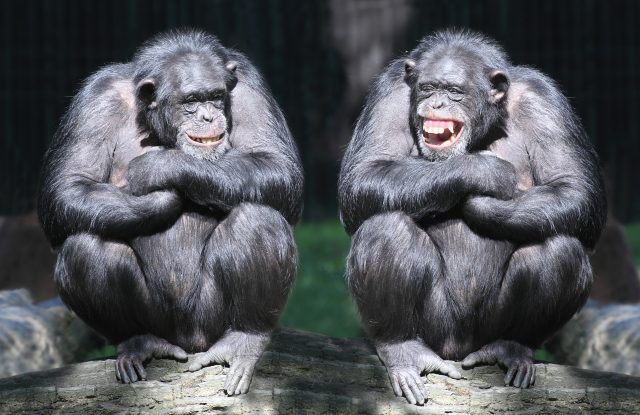
Chimpanzees in Africa could be consuming as much alcohol as two standard drinks a day through the fruit they eat, a UC Berkeley study has revealed.
Researchers measured the ethanol content of 21 fruit species eaten by chimps at two long-term study sites: Ngogo in Uganda’s Kibale National Park and Taï in Ivory Coast. They found that, on average, the fruit contained 0.26% alcohol by weight.
With chimps eating around 10 pounds (4.5 kilograms) of fruit daily, the calculations suggest an intake of roughly 14 grams of ethanol each day — the equivalent of one U.S. standard drink. Adjusted for body weight (chimps average 40 kilos compared to a typical human’s 70 kilos), this rises to nearly two drinks.
“Across all sites, male and female chimpanzees are consuming about 14 grams of pure ethanol per day in their diet,” said UC Berkeley graduate student Aleksey Maro, who led the study. “When you adjust for body mass, because chimps weigh about 40 kilos versus a typical human at 70 kilos, it goes up to nearly two drinks.”
The ‘drunken monkey’ hypothesis
The findings support the “drunken monkey” hypothesis proposed by UC Berkeley professor Robert Dudley, who co-authored the paper. The theory suggests that human attraction to alcohol has evolutionary roots in primates’ diets of ripe and fermented fruit.
“The chimps are eating 5 to 10% of their body weight a day in ripe fruit, so even low concentrations yield a high daily total — a substantial dosage of alcohol,” Dudley said. “If the chimps are randomly sampling ripe fruit as did Aleksey, then that’s going to be their average consumption rate, independent of any preference for ethanol. But if they are preferring riper and/or more sugar-rich fruits, then this is a conservative lower limit.”
Partner Content
Despite the steady intake, researchers reported that chimps show no visible signs of intoxication. Maro noted that to become inebriated, an ape would have to eat so much fruit that its stomach would bloat. Instead, the study suggests that chimpanzees, and by extension human ancestors, experienced regular low-level exposure to ethanol in the wild.
“Chimpanzees consume a similar amount of alcohol to what we might if we ate fermented food daily,” Maro said. “Human attraction to alcohol probably arose from this dietary heritage of our common ancestor with chimpanzees.”
Collecting evidence
Fieldwork took place between 2019 and 2021. Maro collected fruit samples freshly fallen or recently dislodged from trees at both sites, and tested them using multiple methods: a semiconductor breathalyser, a portable gas chromatograph, and a chemical test. Each method gave similar results, with weighted averages of 0.32% ethanol at Ngogo and 0.31% at Taï.
At Ngogo, figs (Ficus musuco) were the most commonly eaten and also the highest in alcohol content, while at Taï, the plum-like fruit of the evergreen Parinari excelsa topped the list. Both are major food sources for the chimps.
The research, published in Science Advances on 17 September, lays the groundwork for future studies. This year Maro has returned to Ngogo to collect chimpanzee urine samples — under an umbrella for protection — to analyse for alcohol metabolites.
Dudley argued that such work highlights the evolutionary importance of alcohol consumption across species. “The consumption of ethanol is not limited to primates,” he said. “It’s more characteristic of all fruit-eating animals and, in some cases, nectar-feeding animals.”
Co-authors of the paper include researchers from the University of Texas at Austin, the Taï Chimpanzee Project, and the University of Michigan. The work was funded by UC Berkeley.
Related news
Stag's Leap 1973 achieves new record auction price
Carlsberg emerges as World Cup winner despite smaller than expected beer boost


