



Beneath the surface: the rise of Australia’s underwater wines
With Semillon, Shiraz and soon Chardonnay and Cabernet Sauvignon maturing 15 metres down, Subsea Estate is proving the ocean has a winemaking future.
From Champagne Shipwrecks to the Southern Ocean
The inspiration for Subsea Estate’s venture came from a shipwreck. In 1998, divers recovered thousands of bottles of 1907 Heidsieck & Co Monopole Goût Americain Champagne from the wreck of the Jönköping, sunk in 1916. The bottles had matured for decades beneath the sea.
That discovery prompted French winemaker Emmanuel Poirmeur to develop a patented subsea fermentation process almost 20 years ago through his company Wine Reef. Now, working with Brad and Jodee Adams at Subsea Estate in Western Australia, Poirmeur has brought the technique to the southern hemisphere.
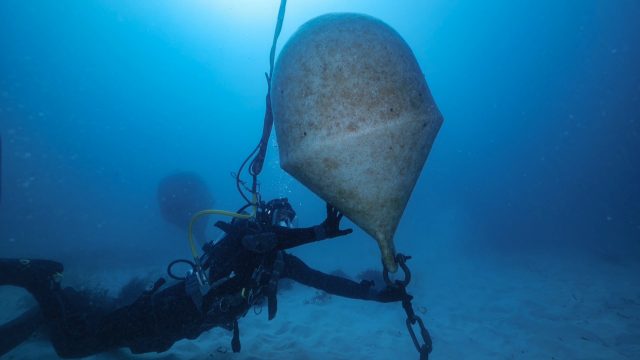
Subsea Estate ferments wines in 265-litre poly vats anchored 15 metres beneath the waves off Augusta. The current range includes Semillon and Shiraz, with Chardonnay and Cabernet Sauvignon set to follow.
Fermentation, not just ageing
Poirmeur stresses that the process is more than ageing underwater.
“It’s important to note that it’s a secondary fermentation, not a simple ageing in the seabed,” he said. “The criteria for the Subsea base wines selections are very different than usual. You have to imagine what kind of aromas you could obtain after that 2nd fermentation, more of a vigorous autolysis.”
More than 35 grape varieties have already been tested. Local grapes are prioritised, with selections guided by both technical suitability and the preferences of local consumers. “Observing the first results obtained by a trial with classical grapes led us to the future,” Poirmeur explained.
The Southern Ocean provides constant movement and stable temperatures of 19–22°C. Each batch spends eight months immersed. “Opening a recovered vat is like opening a huge bottle of Champagne,” Brad Adams, Subsea Estate, general manager and co-founder said. Wines retain a subtle spritz, with bubbles mostly filtered before bottling.
Ocean-crafted style
According to Poirmeur, the flavour differences between ocean-crafted and land-crafted wines are marked.
“With white and rosé wines, we avoid the sensation of alcohol as if the wines are lower after than before the 2nd fermentation, which is technically the opposite. The acidity is polished by a smooth texture, probably due to the yeast autolysis,” he said.
Partner Content
“For the reds, we have a huge gain in structure and volume as if they were barrel aged for a long time, but still keeping their fruity and young wine taste.”
Subsea Estate embraces the unpredictability of ocean conditions. “Every immersion is different,” Adams said. “They’re wines of adventure.”
Scaling up
This year, Subsea Estate will release 15,000 bottles, some entirely subsea-fermented, others blended with land-based wines. The goal is to scale up to 100,000 bottles across its 413-hectare site.
“Increasing capacity is exactly like in a classical barrel cellar, except that our winery cellar is below the sea and difficult to access,” Adams explained. “To increase capacity, we need more patent vats and screw anchors to fix them to the ocean floor, but we have a large lease capacity, so we can expand.”
Poirmeur added that the patented technology has already been proven in France, even in sensitive marine environments. “Be respectful with the marine environment is the first commitment of Winereef. If there is any doubt, we don’t want to play with it.”
Customers and markets
Subsea wines appeal across the spectrum, Poirmeur argued. “Wine experts, wine lovers, wine insiders, a lot of winegrowers and winemakers, curious or doubtful people, regular and occasional consumers… I’m not comfortable with categorising people. We are probably all in some of these categories at the same time on the same day or week.”
As for exports, Adams emphasised that local markets come first. “Each Winereef has its own area of exclusivity, and we have to respect the first customers, those who are living there and those who are dreaming like us about the ocean. Exporting our wine is a happy consequence of the local success, not an absolute goal or a strategy.”
Still, ambitions go beyond Augusta. The team is eyeing projects in other parts of Australia, South-East Asia, South Africa and Miami.
A new frontier for winemaking
For Poirmeur, subsea winemaking remains a blend of science, terroir and imagination. “Spontaneously, talking about the ocean and diving has a taste of adventure, of hidden treasure and kraken. So we have to surprise with our wines,” he said.
With production now set to multiply and demand rising, Subsea Estate is charting new territory — proving that wine matured beneath the waves can hold its own above them.
Related news
Master Winemaker 100: Cynthia Ortiz
Château du Tertre partners with Ulysse Cazabonne to launch 'iconoclastic' white blend


