



‘They’re not going anywhere’: Octopi surge shakes up restaurant menus
A recent boom in octopus numbers in England’s south-west coast, driven by warming sea temperatures, has led to a dramatic fall in crab, lobsters and scallops, which the octopi prey on. For restaurants, it’s a double-edged sword.

Restaurants are getting creative to capitalise on the octopi surge along England’s south west coastline, but it’s also led to a shellfish shortage and sky-high hake prices.
Experts believe the sharp increase in octopus numbers to be fuelled by warming sea temperatures. It has led to a dramatic drop in the number of shellfish, like crab, lobsters and scallops, which the octopi eat.
Environmental experts worry about what it means for climate change, but for English fishers, the hoards of octopi are a financial win. There’s no quota, and a large market, particularly in Spain, fetching £8 a kilogram at auction.
While 70-80% of the seafood caught is sold abroad, UK restaurants are also making the most of the fishy situation. At Crave, Exeter, the octopi influx had been a double-edged sword. Speaking to the drinks business, the independent eatery’s head of development and growth Tom Lodge said: “We’ve had the premium of having this octopus in the waters where it usually isn’t, turning it into a positive spin and putting on specials, like black garlic aioli octopus with fried nduja and breadcrumb.”
Harder to sell

“But then we’ve had the negative effect of not being able to get lobsters at a fair price, or not being able to get a whole crab. Devon crab is such a delicacy, and it’s a shame the octopus has been tearing them all up,” he added.
The octopus, which has three hearts and nine brains, uses its beak to crack the crab shell, and then injects enzymes to help dissolve the meat before sucking it out.
The Devon and Severn Inshore Fisheries and Conservation Authority enforce a bylaw that requires ‘escape gaps’ to be fitted to crab and lobster pots to allow undersized shellfish to escape. But fishers believe octopuses are finding ways into these and leaving after eating the sea creatures.
It’s not just crabs, but sardines and mackerel that are a struggle to find, said Lodge. Additionally, octopus is a harder sell than lobster – it doesn’t have the latter’s reputation for luxury.
Despite this, seafood restaurant the Club House in West Bexington said customers had been receptive to tasting the tentacle-clad ingredient. The restaurant’s head chef William Hickton is working with local fishermen to turn oversized hauls into an eclectic feast. Through freezing, grilling, steaming and dressing the octopus, he’s invented Mediterranean-inspired dishes like fire-roasted octopus with romesco sauce and crispy potatoes, and chargrilled octopus with saffron and garlic mash. Bulk-buying octopus and smoking also preserves it for longer. “It’s delicious, sustainable, and a great way to support the local boats,” said Hickton.
An ongoing problem

But for the restaurant’s owner Maisy Attrill, the octopus boom is a big issue. “They’re not necessarily meant to be in our waters, so it was affecting the ecosystem along our coastline,” she explained to db. “Lobster and crab would normally have come down in price going into the season, but it was either remaining at the set price or for more off-season because it was rarer.”
Partner Content



Hake costs are also through the roof, she added, as fishers had abandoned netting the fish in favour of octopus, to cash in on strong demand in Spain and Portugal.
“I can see this being a problem in future years.” Attrill forecasted, with the UK set to face further sea temperature spikes with the rising of global temperatures. Climate change will change how we drink wine, but it’ll also impact our palettes: “As the waters get warmer, we’re going to have the octopi over here for longer, so people do need to be open to the fact that the ecosystem is changing, and people have to change with it, and change what they’re eating.”
London gets its sea legs

And it’s not just on the west coast that operators are feeling the effects. Ed McIlroy, co-founder of Four Legs, north London has seen octopus prices plummet: “We like cooking it because we’re quite good at it and not many, if any, places in London serving as simply as Tollington’s, just off the plancha with salt and lemon zest. It’s also great to champion as an English product, as historically it is more associated with Spain or Portugal, and up until recently frozen octopus from those waters was all that was available from suppliers in London.”
Isaac McHale, chef-owner of Bar Valette, east London, is also featuring lots of “amazing quality octopus” on the menu, and Lorne Restaurant, also in the capital, has been getting creative with the fish – serving it up alongside oxheart tomatoes, crispy polenta, a black olive crumb and sauce vierge.
And 45 Jermyn St, central London has added an octopus carpaccio dish to the menu for the first time. “We typically only want to serve seafood that comes from UK waters, so it’s the first time we’ve been able to put it on the menu,” executive chef Sam White told db. “We’re always developing the menu reactively, so when the brown crab prices are too high or it’s not available at all, we use spider crab as a substitute instead. The spider crabs aren’t targeted so much by the octopus population because of their size and spiky exterior.”
Not a net win
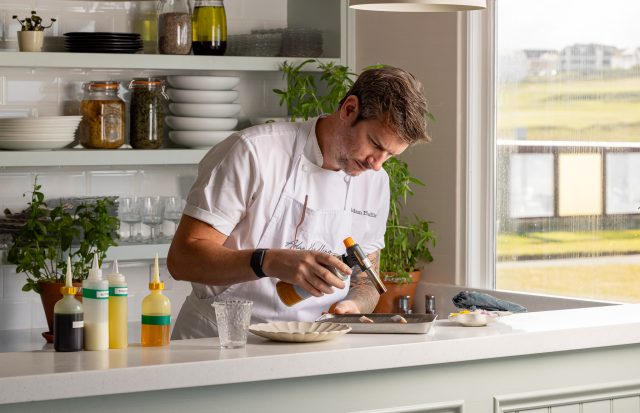
White, whose seafood supplier is restaurant chain and online seafood market Rockfish, said the new dish had been “amazingly popular’. But, according to Rockfish CEO Mitch Tonks, this wasn’t the case across the board. Overall, there wasn’t really an appetite for octopi in the UK, nor the chefs wanting to cook it, he said.
Perhaps this explains why some restaurants had dodged the impact of the octopi uptick. Adam Handling’s Cornish venues, Ugly Butterfly 2.0 and the Tartan Fox, had continued to serve up shellfish. “No changes yet but, if there are more octopi available, we’ll definitely add it to our menus,” executive chef Adam Handling told db. “We love it.”
Meanwhile, Rockfish sites had grappled with a crab shortage, partly due to the octopus population and partly due to fishing pressure.
Tonks said: “They’re voracious predators eating their way through crabs that are caught in pots and scallop beds,” said Tonks. “The last time this happened was in 1952, they stayed for two years and each female lays between 4-500k eggs so they aren’t going any time soon.”
But he added that lobsters had been plentiful, with disco scallops also coming in thick and fast. “People love to eat locally landed fish when they come to the seaside, and our menu reflects that,” he added.
Related news
Areni Global: 'We have to find a way to make wine consumption safer' for women amid spiking fears


