



Asia’s private members’ clubs are bullish about the future
Despite tough times for bars and restaurants, it’s not all doom and gloom for Asia’s on-trade, with private members’ clubs boosting floor space and prioritising international expansion into the region’s most promising markets.

In June, 67 Pall Mall announced landmark news: the private members’ club would be opening a new site in Shanghai, its first in Mainland China.
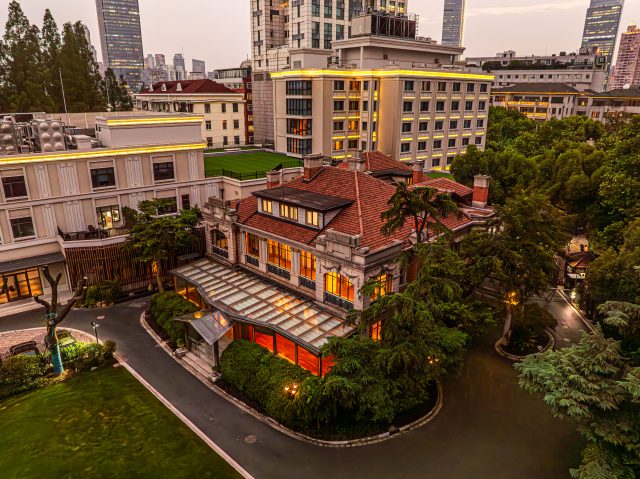
Housed in a 100-year-old French Renaissance-style garden mansion (pictured next page) in the Xuhui District, also known as ‘West Bund’, the Shanghai outpost will feature a Grand Salon, a Champagne bar and wine library, and an extensive spirits selection, from whiskies to baijiu. Renovations are scheduled to start shortly, with an anticipated opening date in 2026.
Founder Grant Ashton opened the first branch of 67 Pall Mall in London a decade ago. Since then, the club has expanded into Verbier, Singapore, Bordeaux and Beaune, with a further club due to open in Melbourne this year.
A multi-million dollar penthouse refurbishment enabled 67 Pall Mall’s Singapore club to open in March 2022. Master of Wine Richard Hemming, head of wine for Asia, leads a 16-strong sommelier team at the site, which offers a 6,000-label wine list, one of the most diverse in Southeast Asia.
Ashton and his team have dedicated significant time and effort into building the 67 brand’s presence in Asia.
In January 2024 the members’ club launched a new category of membership in cities where it has no permanent physical presence, and Hong Kong became the first to debut the new offering.
“Hong Kong is the most developed and most competitive wine market in Asia: it’s a challenging market, but one with excellent visibility,” Hemming told db Asia in March.
“Wine lovers there are both highly discerning and highly curious. Plus, of course, it is closely connected to the Chinese Mainland, which helps from a practical and logistical point of view.”
But 67 Pall Mall isn’t the only wine-focused members’ club tapping into Hong Kong’s potential. Michael Wu, founder of The Fine Wine Experience, Hong Kong’s leading Burgundy merchant, and seasoned restaurateur Randy See of Piccolo Concepts (a subsidiary of Singapore’s Les Amis Group), launched Club Bâtard in 2024.
The Club took over the 100-year-old historic Pedder Building in the heart of the city. In 2019 Wu and See launched Bâtard: a French restaurant inside a fine wine shop in Sai Yin Pun. The concept behind Bâtard as a restaurant was to offer clients the chance to order wines without restaurant mark-ups, offering savings of 60%-70% compared with other venues.
Hong Kong’s challenging market conditions and the impact on hospitality businesses has been well-documented in recent years. Changing consumer habits and economic woes have caused a growing numbers of bars, restaurants and on-trade venues to close their doors.
Partner Content

Singapore, another of Asia’s drinks capitals, tells a similar story. The food and beverage industry in the city state continues to face multiple challenges, including escalating rent, rising operational costs and a manpower crunch.
Singapore witnessed record-breaking venue closures in 2024. According to government data, 3,047 food and beverage establishments closed last year, the highest number in 15 years. The downturn continues in 2025, with 1,404 venues having closed in the first half of the year. However, the opening of new establishments has outpaced the closures, equalling 3,793 in 2024 and 1,964 in 2025 so far. Still, the business environment remains tough.
Members’ clubs, though catering to high-net-worth clientele, who are better shielded from financial strains, are not entirely protected. On 17 June Singapore’s 1880 announced it had closed without warning after eight years in business. Located in Robertson Quay, its holding and operating companies were placed under provisional liquidation. This followed the sudden shutdown of its Hong Kong branch in May after less than seven months.
In an email to members, 1880 said it was shutting down because spending and visits by its members had been “trending down”, while its efforts to secure new investors or a buyer for the club ultimately fell through. The company also cited funding woes surrounding its expansion plans.
However, just weeks after the club’s closure was announced, it issued another statement declaring it would reopen at the same site.
A spokesperson confirmed that the new club would open in August and occupy the same space as its predecessor. More than 90% of the employees who had worked at the shuttered club will return, the spokesperson said. However, the three co-founders of 1880 – Marc Nicholson, Jean Low and Luke Jones – will not be involved in the new venture.
Healthy appetite
Despite 1880’s recent struggles, the appetite for private members’ clubs in Asia remains healthy. Mandala Club in Singapore’s Bukit Pasoh Road is growing its floor space by taking over a building next door.
And 67 Pall Mall is looking to more cities with vibrant wine communities to extend its new category of membership without a physical club – namely in Dubai, Tokyo and Bangkok.
For Soho House, a global members’ club with spaces in Europe, North America, and Asia, India has been bookmarked as the next growth market. The company, which was founded in London in 1995, has announced that two new venues, in Delhi and Mumbai, are set to open in the coming years. Soho House’s first offering in the country – an ocean-facing club on Mumbai’s Juhu Beach – opened six years ago, and continues to be popular among affluent Indian consumers.
The chain is one of a host of new club entrants vying to cater to a market that is booming in India.
Related news


