



Three jailed for human trafficking after workers ‘treated like slaves’ in Champagne
“You don’t play with the health and safety of seasonal workers. Nor are we playing with the image of our appellation,” warns the Comité Champagne after a landmark ruling saw jail time doled out and a winemaking co-operative fined €75,000.
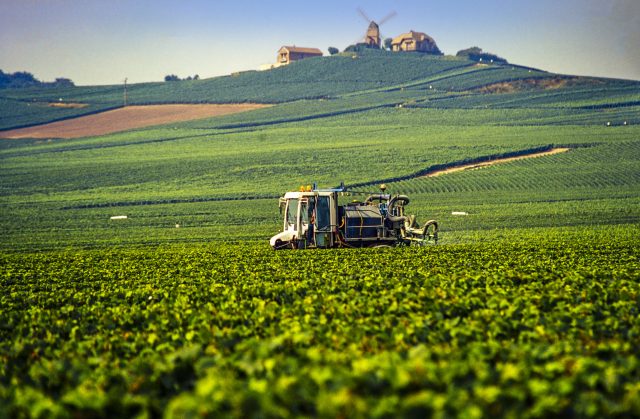
A court case heard on 21 July found three people guilty of human trafficking and exploiting seasonal workers within the Champagne industry.
More than 50 victims, all undocumented migrant workers from Mali, Mauritania, Ivory Coast and Senegal, were found during the September 2023 harvest living in cramped and unhygienic conditions in Nesle-le-Repons in the Marnes department of Champagne.
The lawyer representing the victims praised the court’s “historic decision” after a judge ordered the company responsible for the worker’s mistreatment to be dissolved, and sentenced three individuals involved to prison time. All three were found guilty of human trafficking — defined under French law as “recruiting, transporting, transferring, housing or receiving a person to exploit them,” by means of coerced employment, abusing a position of authority, abusing a vulnerable situation or in exchange of payment or benefits.
Each of the three found guilty were also ordered to pay €4,000 per victim.
Servicing company
The company at the heart of the controversy is Anavim, described as a ‘servicing firm’ in Champagne. The director of Anavim, a Kyrgyz woman in her forties, was sentenced to two years behind bars, with a further two years suspended.
Meanwhile, the court in Chalons-en-Champagne also sentenced two men in their thirties to one year each in jail.
The court ordered Anavim to be dissolved as a company, and instructed a winemaking cooperative it worked with to pay a €75,000 fine.
Intends to appeal
A lawyer for the convicted Anavim director said he plans to appeal the decision, and appeared to point the finger at the Champagne industry for an issue he implied was ongoing.
“My client is the ideal culprit for an industry that has long turned a blind eye to its own practices,” said Bruno Questel.
The Anavim director denies being responsible for the workers’ housing conditions, blaming the two other defendants suspected of recruiting the harvesters for the “appalling” sanitary state of the accommodation. According to the labour inspectorate who examined the housing for the grape pickers, the conditions “seriously undermined” their safety, health and dignity.
Partner Content


“They put us in an abandoned building, with no food, no water, no nothing,” added Modibo Sidibe, one of the victims, who said the workers were working 13-hour shifts in the vineyard from 5.00am until 6.00pm.
Harsher punishment
Following the verdict, trade body the Comité Champagne has called for even harsher punishment for offenders in a hope it will deter further mistreatment. “What we are asking for is the downgrading of the harvest in the zones where the offences were committed, so it could no longer be used to produce Champagne,” said general secretary Jose Blanco.
“You don’t play with the health and safety of seasonal workers. Nor are we playing with the image of our appellation.”
In a separate legal case, a service provider and its manager is expected to face trial in November on suspicion of having housed 40 Ukrainians in unfit conditions.
Rising temperatures
It’s not the first time that questions have been raised over the treatment of seasonal workers in Champagne.
In 2023, db asked whether a new approach was needed for grape picking in Champagne, following the death of four workers after they were overcome by 38 °C temperatures. Maxime Toubart, president of the SGV, the main growers’ union in Champagne, said at the time: “We are not used to harvesting in temperatures like this.”
The managing director of one Champagne house, who asked not to be named, told the drinks business: “The harvest used to be a fantastic moment… it used to be fun.
“But is it the best way to pay people by the kilo when it’s 35 degrees outside and they’ve had four hours sleep?”
The MD mooted that it made sense to stop paying grape pickers by the kilo, saying that when workers are being paid by grape weight there is “always a risk of over-exertion” in order to pick as many grapes as possible and increase their wage.
Reduced yields
This week, the region of Champagne set its 2025 yields at the lowest level this century, aside from 2020, when the first Covid-related lockdowns led to a sharp decline in sales. The ‘available’ or ‘commercialisable’ yield (which is the maximum amount that can be made into wine for selling from this harvest) has been set at 9,000 kg/ha for 2025, the equivalent of around 255 million bottles
“This decision reflects a clear-headed, united, and responsible Champagne region, capable of acting with restraint in an evolving world while maintaining unwavering confidence in its fundamental strengths,” said Toubart.
Related news
The UK’s Definitive Champagne Tasting returns to London in April
Why Champagne performed better in 2025 than the figures suggest
Alice Tétienne steers Champagne Henriot to a sustainable future


