



Louis Roederer looks back to face future in Champagne
In a bid to bring ‘resilience’ to Champagne in the face of climate change, Louis Roederer cellar master Jean-Baptiste Lécaillon is employing the techniques of the past.
It’s been well documented that Champagne has benefitted from warmer and drier vintages, but also that the region has suffered from climatic extremes – such as frost, hail and heatwaves – as well as difficult harvests, particularly those in 2021 and last year, when wet and warm conditions led to widespread mildew infection in the vines.
With such a varied set of viticultural challenges for the vignerons, it’s hard to know what techniques to employ, or, in the long term, what approach to take in the vineyard.
But Jean-Baptiste Lécaillon believes he has one answer, which is to look back to the historical techniques of growers in Champagne, who faced difficult weather without the technology of today.
Such approaches may not be the answer to all the vigneron’s threats, but should increase the vineyard’s capacity to handle increasingly varied weather.
And one key change Lécaillon is making, albeit on an experimental basis, is to replant his vineyards with a mix of vine varieties, while using the full range of grapes allowed in Champagne – aside from the new hybrid, called Voltis.
Co-planting like the past
Known as a field blend, this sees a vineyard incorporate a range of grapes planted together, rather than segregating them into blocks. Not only that, but it means harvesting them at the same time, as opposed to the usual approach, which sees picking times done according to grape variety, as well as location.
As for the varieties, these include the main three Champagne grapes – Pinot Noir, Meunier and Chardonnay – but also Petit Meslier, Arbane, Pinot Gris and Pinot Blanc, sometimes referred to as the ‘forgotten grapes’ of the region, as they were once widely planted, but have now virtually disappeared from the 34,000 hectare appellation.
To test the results of such an approach, since 2006, Louis Roederer has made a single vineyard, single harvest Champagne, but only in the warmest years, and without any added sugar.
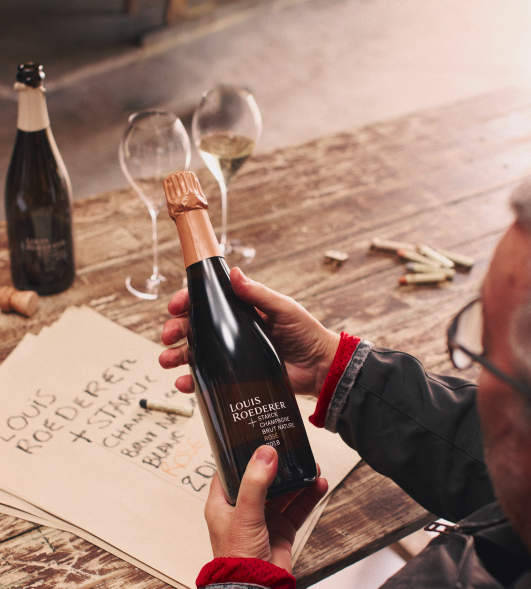
“It is our witness of climate change,” Lécaillon explained at a press event in London last week, where he launched the latest vintage of the expression – the 2018 vintage, Brut Nature, which is a collaboration between Louis Roederer and Philippe Starck.
Starting in 2006, Lécaillon said, “The cuvée is only made in hot, dry years that could represent the future,” before commenting, “It is a field blend coming from one vineyard.”
Cool soils and sunny slopes
Based in Cumières, and planted on cool clay-rich soils overlying chalk, it is a 10-hectare site facing south and south-east, ensuring it receives plenty of sunlight.
Partner Content
Notably, the vineyard features all aforementioned seven historical grapes of Champagne, planted together, allowing them to be picked at the same time.
The benefit of this past technique according to Lécaillon is to strengthen the vineyard against disease and extreme weather by increasing the diversity, which he said “brings resilience,” adding, “in the past it [field blends] were key to the wine, and it may become key again.”
As for harvesting the grapes at the same time, that brings “freshness” to the Champagne, according to Lécaillon.
The site is also organic, having achieved certification in 2004, and the resulting wines are gradually incorporating all of the varieties as they reach maturity.
“We picked the grapes on 2 September,” recorded Lecaillon of the 2018 release, noting, “It was all picked in the morning in four hours.”
Featuring in the 2018 blend alongside the Pinot Noir, Meunier and Chardonnay was 1% Pinot Blanc, because “it was only just coming into production”.
Speaking about this particular grape, he added, “We found a very interesting massale selection of Pinot Blanc from a grower in Champagne, which we planted to bring some roundness and texture to the blend.”
Pristine fruit
Not only is the Champagne from this plot bottled without any sugar, but the wine doesn’t go through malo-lactic fermentation.
“It is very pure, with no winemaking or blending techniques behind it: the idea is to bring this pristine fruit expression from the vineyard,” he said.
Having said that, there are some touches that show the winemaker’s hand, one being oak fermentation on one third of the wine – as well as ageing on the lees for 12 months to bring some body to the blend – while the other is the decision to bottle the Champagne at a slightly lower pressure (5 bar rather than 6), to ensure the single-harvest, bone-dry fizz has “tinier, creamier and softer bubbles.”
In terms of releases, Louis Roederer has made a Brut Nature from this site in 2006, 09, 12, 15 and 18 vintages, with, in the future, further expressions expected to come from the 2020 and 22 harvests, and, it is thought, from this vintage too, which as previously reported by db, is hot, dry, and disease-free.
Related news
Top 10 ways Champagne is tackling climate change


