



Laurent-Perrier targets modern Champagne lovers with bold, affordable new release
Laurent-Perrier’s newest cuvée, Héritage, blends innovation and tradition to reinvigorate Champagne’s appeal in a sluggish market. With a nod to its history of category-defining releases, the House aims to win over contemporary palates — and budgets.
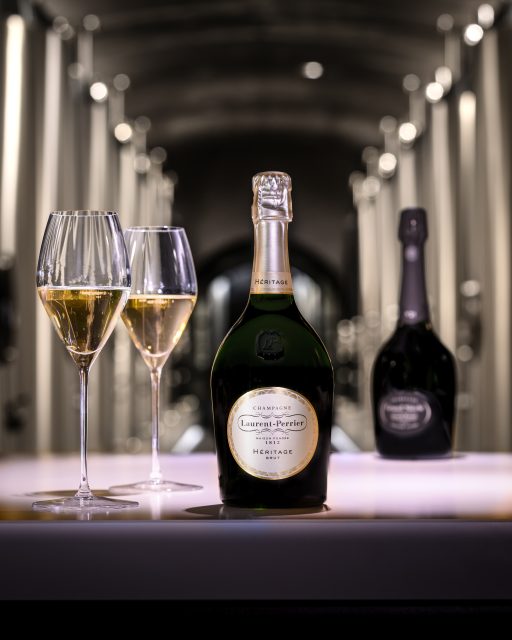
Few centuries-old wine companies embrace innovation and tradition with equal ardour. But those that do, like Laurent-Perrier, manage to create an opportunity to be enthusiastically sought after by both the old and new guard of wine lovers.
That opportunity is being eagerly pursued as we speak, especially in the US. Will the market respond? It’s no secret, after all, that the current market for Champagne is lodged in a deep rut. Sales of Champagne declined 9.2% last year, with the US remaining the region’s No. 1 fan in volume and value.
Laurent-Perrier has not been immune to the gloom, despite its general long-standing popularity.
The house was founded in 1812, but its modern era began in 1948, when Bernard de Nonancourt assumed control of Laurent-Perrier from his mother, Marie-Louise Landson de Nonancourt, who had acquired the house in 1939.
When Bernard took charge, the house sold around 80,000 bottles a year. Today, it produces more than 7 million bottles, thanks to a series of courageous innovations that changed the way Champagne was conceived of and consumed that turning it from a sleepy house into one of the world’s largest trend-setting Champagne producers in the world, the fifth-largest by volume and the second-largest by value.
“The growth was marked by bold innovations and a clear stylistic vision,” says Olivier Vigneron, cellar master of Laurent-Perrier. “Laurent-Perrier became a pioneer in the region, introducing the cuvées marked by Bernard’s vision of the House’s style defined by freshness, purity and elegance. This signature style, supported by a commitment to sustainable viticulture and excellence in blending, played a major role in the remarkable rise.”
After Bernard died in 2010, his daughters Stéphanie Meneux de Nonancourt and Alexandra Pereyre de Nonancourt took control of the house to continue to execute his ambitious vision.
Recently, Laurent-Perrier’s growth has stalled, although its revenue has ticked up slightly.
As of March 31, 2025, group revenue from Champagne sales declined -6.8% year-over-year. But operating profits were up US$87.25 million, something that Stéphane Dalyac, chairman of the management board, attributed to “the quality of our wines, the control of our distribution and the investments made to support our brands,” in a publicly released financial statement. (Laurent-Perrier is one of the few family groups of Champagne listed on the stock market, and includes Laurent-Perrier, Salon, Delamotte and Champagne de Castellane brands. It went public in 1999).
The decline of Champagne mirrors a downturn in luxury goods overall. Between 2019 and 2023, the demand for luxury wine, fashion and jewellery allowed the sector to achieve a 5% compound annual growth rate, outpacing global markets and exceeding previous profitability records, according to a report from McKinsey & Company. But this year, McKinsey predicts a decline amid macroeconomic headwinds.
Can Laurent-Perrier recapture its sales mojo with a new release that reflects its long-standing approach to transformative change rooted in tradition?
A new first
Bernard fueled Laurent-Perrier’s initial growth spurt by changing how wine was defined writ large.
“Several decades ago, Champagne was mainly served as a dessert wine and was typically very sweet, with a high dosage,” says Vigneron. “Bernard challenged this tradition by envisioning Champagne as a true gastronomic wine: one that could be served throughout the entire meal, not just at the end.”
There were several recalibrations, but three of particular importance: the introduction of Grand Siècle in 1959, the revolution in maceration via the Cuvée Rosé in 1968, and the pioneering of non-dosage with the Ultra Brut in 1981.
Their latest innovation, Héritage, the first Brut Champagne made from 100% reserve wines, reflects both the House’s love of and talent for creating completely new categories of sparkling wine, but also market realities.
“Héritage is part of our modern approach to blending, offering greater flexibility,” says Vigneron. “At its core lies the savoir-faire of blending reserve wines, inspired by the vision of Grand Siècle, but interpreted in a broader way.”
Grand Siècle follows a more rigorous framework, blending three distinct vintages of character from Grand Cru terroirs in an ideal ripening year. They are composed primarily of Chardonnay, complemented by Pinot Noir and aged for 10 years on the lees before being released. Since debuting in 1959, 26 have been released.
Each vintage is aged in their cellar dedicated to reserve wines. Each grape, Cru and vintage is vinified and reserved separately. To keep the number of vats to 300, and to maintain the House’s trademark fresh and transparent style, no wine is kept for longer than 10 years.
The financial investment to maintain and monitor such a vast collection is significant, but it has laid the groundwork for its latest offering.
Héritage was conceived of as the Grand Siècle’s more affordable (US$75 vs US$225+) and broadly appealing offshoot.
Partner Content
“You will find primary aromas that reflect the Champagne terroir and the Chardonnay and Pinot Noir used, but also a complexity and a distinctive vibrancy in the cuvée,” Vigneron says, adding that the blend of reserve wines and five years’ ageing lends “greater depth and a silky texture” to the low-dosage Champagne.
Elevating nature, meeting market desires
Great wine and Champagne require an idyllic vintage and terroir. Climate change has made that archetype more difficult to attain, which has been another consideration Vigneron and his colleagues took into account when creating Héritage.
“Climate change creates more chaotic vintages, with sharper contrasts and more extreme weather events,” says Vigneron. “This is where the strength of blending truly comes into its own, as it gives us the ability to seek out the best from each region and adapt as effectively as possible to these changes. Our strength also lies in our unique expertise in selecting and preserving reserve wines.”
In the 1970s, the House introduced the first stainless steel tanks and thermo-regulated winery in Champagne, which helps capture the purity of the grape’s flavours and avoid premature oxidation. This also helps lock in the freshness that has been a calling card for Laurent-Perrier for decades.
The blends are designed, he continues, to be gastronomic wines, partially as a continuation of the tradition that Bernard launched with Grand Siècle, but also in recognition of a contemporary desire to pair Champagne with a range of flavours and cuisines.
Michelle DeFeo, president at Laurent-Perrier US, says the team intentionally introduced Héritage through their long-standing partnership with Alinea Group, led by Chef Grant Achatz. To toast Alinea’s 20th anniversary, Achatz embarked on a coast-to-coast culinary tour, offering opportunities to try chef-curated food and wine pairings, starring Laurent-Perrier Champagnes, with an exclusive offering of Héritage.
“Héritage is such a unique and innovative Champagne, so introducing it in the US by partnering with Alinea was an authentic fit that really resonated with people,” DeFeo says. “Starting in September, it will be more widely available in select wine shops and restaurants.”
Bridging past icons with present demands
The new SKU is also a bridge between the aspirational and exclusive Grand Siècle and the brand’s wildly popular, gently priced La Cuvée (US$60) and Cuvée Rosé (US$90). It is a bridge in price, but also technique and intention.
Like the introduction of its Grand Siècle, the Rosé was a Champagne category-creator. Rosé Champagnes were not in style, and Bernard was the first to create a macerated expression, instead of the blends that existed previously.
“Laurent-Perrier is best known throughout the world for our Cuvée Rosé,” DeFeo says. “It catapulted the brand to renown when it was first released back in 1968.”
By offering a similar experience as Grand Siècle and a significant innovation in technique a la the Rosé, Héritage aims to meet diners where their palates and wallets are, in a sweet spot between premium and ultra-premium.
“While growth of our non-vintage brut La Cuvée is outpacing the market, our higher-end wines continue to represent more of our value each year,” DeFeo says.
The first release of Héritage is a blend of 55% Chardonnay and 45% Pinot Noir, from 40 Crus, half of which are Grand Crus. The blend incorporates wines from 2014, 2016, 2018 and 2019, giving the cellar team more material to work with and fewer constraints. In other years, the number of harvests featured in the blend will vary, allowing for an almost endless number of variables.
But it will remain, Vigneron says, based on Laurent-Perrier’s dedication to “fresh, elegant and pure styles that complement the finest cuisines.”
Jon Leopold, Wine Director for The Alinea Group, says that when he first tasted Héritage, he was “blown away by how special it was.”
Leopold included the new release on the Group’s 20th Anniversary World Tour, for the character and flavour it exhibits on its own, but also when paired with Alinea’s tasting menu.
“Héritage has all of the precision, detail and poise I’ve always loved from Laurent-Perrier, but with added depth and complexity from the additional lees-ageing and the 100% Reserve wines used in its production.”
Héritage has been included in classic pairings featuring caviar, but Leopold says its complexity also allows for more unexpected matches.
“We’ve used Héritage in a different light for two iconic Alinea dishes,” he says. “The Black Truffle Explosion and Hot Potato, Cold Potato, showcasing how it can also play wonderfully with the savoury richness of black truffle and salty umami undertones of Parmigiano Reggiano.”
Will Héritage continue Laurent-Perrier’s streak of category-creating revenue-pounding releases? Time will tell; macroeconomics is a tough foe to battle, and markets can be fickle. But all of the elements for a success story have been carefully lined up.
Related news
The UK’s Definitive Champagne Tasting returns to London in April
Why Champagne performed better in 2025 than the figures suggest
Alice Tétienne steers Champagne Henriot to a sustainable future


