



Does this 0.5% mood-boosting beer reduce social inhibitions?
Gaba Labs has released two alcohol-free beers that work with the brain’s receptors to offer greater social ease. Jessica Mason reports.
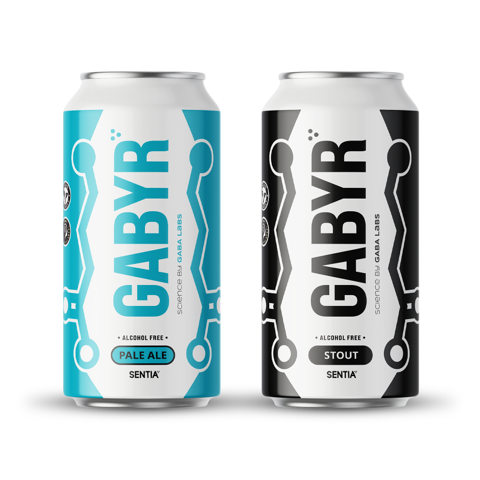
The 0.5% ABV beers, named Gabyr and co-founded by neuropsychopharmacologist Professor David Nutt, are available as a pale ale and a stout and have been contract brewed by Bristol-based brewery Wiper & True.
Each of the beers contain ingredients that have been designed to support the body’s own GABA systems – those responsible for feelings of ease, connection, and conviviality- through carefully researched and selected botanicals, without the need for alcohol.
Speaking to the drinks business, Gaba Labs drinks development lead Matt Coulshed said: “We want to feel something as humans. Humans need to be social, but we’re not always feeling good enough. This is the idea, it gives you that extra little push and makes you feel happy in a group and more talkative.”
Describing the thinking behind the brand, at the beer launch this week, Gaba Labs CEO David Orren admitted: “It’s our mission to bring a capability to the drinks industry to enable healthy adult social drinks that allow us to come together and do what we’ve been doing for 1,000s of years over a glass, but in a healthy way. Just like the coal industry was limited and yet allowed us to become industrialised and then we needed to go beyond that to solar power, we also believe it’s time to change how we drink for the better and to bring science to that.”
Orren explained how “Professor David Nutt has spent 30 years investigating the GABA receptors that allow that sense of conviviality, that allows social beings to come together and connect”.
Orren revealed that releasing the beers has been a long-game and highlighted how Gaba Labs had previously already launched Sentia, its adaptogenic spirits alternative to great success. He pointed out: “In order to popularise the idea that there was an alternative way to come together and socialise, we developed something called Sentia. It allowed us to take extracts and put them together in a certain architecture, and we’ve worked really hard on the flavour so that it tastes like something that we enjoy. But the reality is, the science here doesn’t look like anything that has been experienced. It doesn’t taste like anything really that came before.”
According to Orren, the beers have been in creation for “four or five years now” since the company and its team of chemists have “been working on the technology and science” as well as research and reiterated how the business has been “working with several universities” to get to this point.
The plight has, however, delivered on its promise and has brought to market a beer that looks, smells and tastes like a beer and yet with a recommendation of no more two 440ml cans, the drinkers can “feel” the effects. He explained: “We’ve now come to a point where we can do something quite different, which is to make something which doesn’t just feel a bit like alcohol, but actually looks like something we’re very familiar with, and tastes like a drink and we think that is quite a breakthrough, because it creates the possibility that we can collaborate with the drinks industry by making that technology available for them to create a range of products that can compete in each of the different markets now.”
Partner Content
The next steps for the company are to make this recipe available to brewers of merit and seek out the best in their fields and categories to look at ways of collaborating over beer launches.
Orren told db: “What we do want is to enable the industry to create a new generation of technologies. So we’re very much a mission-driven, scientifically-based company that’s created drinks as a proof of concept, which thankfully have become actually very popular, and we keep having to make more and increase our production. So something that began merely as a proof of concept has also become quite a successful business.it is growing at several 100% a year. That in itself creates challenges, but that has also helped us to fund some of the research.”
Coulshed also admitted: “We want to make a lager next, but we have to be really careful with the botanicals that we use, so you don’t taste them too much. You’ve got to get the amount exactly right. There has to be a certain amount of balance. For the lager we will probably work with other breweries and soon there might be some other alcoholic products being made as well. There might be a cider at some point and want to work with cider makers to speak further.”
Coulshed identified how, although the zero-alcohol industry was answering a desire for moderation, often it under-delivered. Indeed, the need was there, but not always the calibre of drink. He observed: “I think there are times when people would feel like, if they buy an alcoholic drink but what they’re getting is just flavoured water and so I think there’s definitely an opportunity to drive value here, but also there are times when it’s more convenient [not to consume alcohol], because maybe you could drive home from somewhere.”
So, why would somebody go for an adaptogenic 0.5% ABV beer like Gabyr over just a standard 0.5% ABV beer? According to Orren it has a lot to do with what the beer offers – relaxation, sociability and a genuine underlying sense that you are not just drinking a nearly-beer, but a product that works with your body and mind.
Orren explained: “Drinking alcohol is a bit of escapism, which is, and I’m not criticising, but that isn’t always us. One of the reasons people often choose it [an alcoholic drink] is because we have social anxieties and inhibitions and because we’re not always comfortable with feeling that we’re enough. Gabyr is one of those things that allows us to actually just feel relaxed enough to be ourselves in a social exchange.”
Orren added: “One of the wonderful things about humans is that we want to be social animals, the brain knows that, and the brain gives you a bit of reward and makes you feel good when you’re in that social exchange situation. It is one of the reasons social beings come together and form communities. But when you look at what we do, you could argue that we are offering the opposite [of alcohol]. We really don’t want you to escape who you are or to be someone else. We actually just want you to have the opportunity to be able to do things and feel more like yourself.”
Professor David Nutt added: “A combination of brain science and botanical research is helping us to deliver better drinking products. We now have the ability to create recognisable drinks that can enhance that sense of conviviality and relaxation that adult social drinkers want from alcohol, without the alcohol.”
Gaba Labs has also revealed the launch of a new zero-alcoholic GABA-enhancing whisky alternative, named Cask, which is also now available via the company’s webshop along with the beers which can be bought in packs of six in 440ml cans. This week the company also gave investors and journalists the chance to try its prototype range of adaptogenic RTD mocktails in the form of a Cosmopolitan, a Paloma and an Espresso Martini which it also hopes to also bring to market soon.
Related news
#WeekInPictures: the Queen visits Plumpton as craft beer and rum move into new territory


