



Ask the expert: Luc Morlet
Winemaker Luc Morlet explains how classic French winemaking brings quality to Napa Valley estate Morlet Family Vineyards.
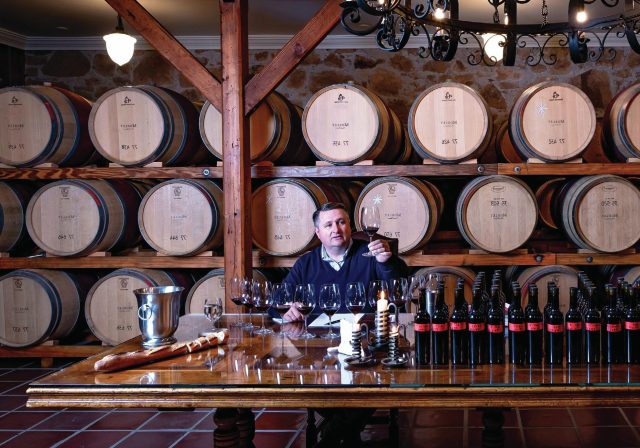
“WHAT MY father strived to instil in us,” says Luc Morlet, “is closeness to nature. It’s to minimise the artifices and the inputs into the wine.” Though Morlet Family Vineyards, which he founded with his wife Jodie, is based in the US, Luc’s winemaking style reflects his French upbringing. Indeed, a central challenge of his career has been to translate this classic French practice to the vineyards of Napa.
From the outset, Morlet was cautious of following trends too eagerly. After leaving France in 1996 to join Jodie, who studied at UCLA, he worried that new technology could desensitise winemakers to the needs of their vineyards.
“I saw my peers being overly analytical,” he explains. “My approach was more about responding to what the vineyard needed, depending on the type of wine.”
Morlet’s family history explains the low-tech approach. As part of a fifth generation Champenois family, Morlet’s father taught him how to plough the old-fashioned way: with their horse. Dealing, quite literally, with one horsepower meant adapting to the weeds and rocks in the earth, whereas a 100-horsepower tractor would power through regardless. It taught Morlet always to be “sensitive”.
Although it is honed by decades of expertise – Jodie terms it “an intuitive sense”. Minimising interventions and additions proves a difficult, continuing work of trial and error.
The goal, however, is a worthy one: multi-layered wines that, in an indication of Morlet’s French heritage, speak of the terroir. He is particularly captivated by the subsoils, which he refers to as the “soul” of his wines. These, as the sources of minerality and distinct characteristics, are vital to the wines, but add another layer of complexity to the endeavour. With its warm climate, California easily delivers ripe grapes, whose bold, fruity flavours could overwhelm delicate notes.
French ideals
Morlet has therefore developed techniques to protect his French ideals of minimal intervention and terroir-driven wines. Often this means acting in the vineyard. For instance, he practises “at-large tannin management” by adding compost rather than fertiliser. As a slow-release source of nutrients, it causes more of a struggle that slowly and evenly ripens tannins. It also binds to the soil’s clay, regulating water in drier times.
Even in water usage (one advantage of looser American regulations), the emphasis is on smaller interventions. “It’s not like we have to use a huge amount of water,” he explains. “A wonderful tool is to spray water on the canopy at night just to freshen it up.” The process ensures that fruit aromas remain fresh and tannins ripen evenly, but it requires attention to the plants, soil and weather forecast.
In the winery, too, careful consideration is essential. Working with his year-round farming team, Luc harvests in blocks of four rows. Each block yields a pallet of grapes: one barrelful. Vinifying them separately, he can track the development of tiny areas of each block. In fact, he does so by blind tasting each barrel, informing his blending by listening to the wines as they develop.
This dedication to sensitive, French-inspired winemaking is evidenced across Morlet Family Vineyards’ practices. It has earned the producer international praise, from Robert Parker hailing Morlet’s “fabulous winemaking talent” to Jeb Dunnuck declaring its Sauvignon and Semillon to be world-beating.
“To be non-interventionistic doesn’t mean you’re lazy. It’s quite the opposite,” Morlet summarises astutely. With a chuckle, he adds: “It actually keeps us very busy all year round. After all, we only have one shot at the perfect expression each harvest.”
Related news
How St. Tropez's local rosé captures Provence terroir


