



‘Europe for the Senses’ campaign launches with collaborative lunch
Etna DOC, Alto Adige DOC and Pecorino Romano PDO are joining forces for a three-year campaign, with much common ground between the regions.
A quick glance at a map is enough to see Italy’s incredible geographical diversity. Spanning 12 degrees of latitude along a narrow peninsula, the land comprises lakes in the Dolomites, Lazio’s hills and Sardinian beaches (plus an active volcano for good measure).
Its history tells of diversity too. By the mid-1850s, while France was busy classifying its Bordeaux wines, the areas belonging to these three Italian denominations spanned five nations. Etna DOC would have sat in the Kingdom of the Two Sicilies, Alto Adige DOC would have belonged to the Austrian Empire, and Pecorino Romano PDO would have been spread across the Kingdom of Sardinia, the Grand Duchy of Tuscany and the Papal States. Alto Adige only officially joined Italy in 1919, meaning that the nation as we recognise it today is barely a century old.
The similarities between the three Italian regions are not as immediate as the differences between them, which in fact formed the basis of their collaboration for the ‘Europe for the Senses’ campaign.
According to Eduard Bernhart, director of Alto Adige DOC, the initial impetus for the collaboration was to look at Italy’s extremes. “We were thinking [about] what could be interesting,” he explains, “and started the idea simply from north to south.” At extreme ends of the country, wine regions easily illustrate the country’s richly diverse terroir.
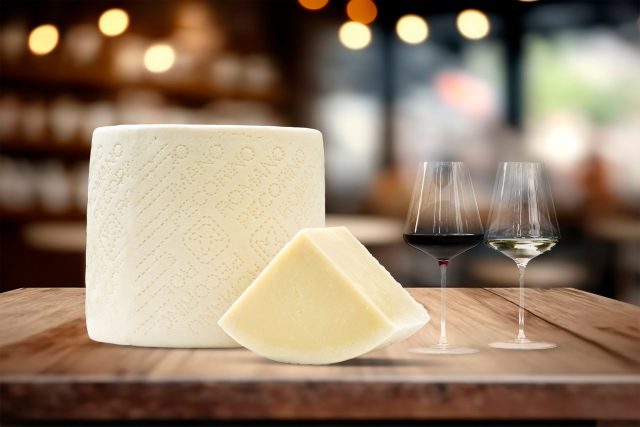
The third partner, Pecorino Romano, adds further breadth to the campaign. With the vast majority of this region’s production based in Sardinia, it added another island to the project’s scope. However, smaller pockets in Lazio and Tuscany also bring central Italy into the fold.
What, then, would unite the three organisations from across the country? The simple answer is neatly highlighted in the campaign’s subheading: “Selezione eccellente from unique landscapes.” Although the regions vary significantly from one another, high-quality products from each are central to their internal strategies, as evidenced by their protected designations under EU legislation.
Bernhart believes that quality, not quantity, is key to the regions, saying: “We are not huge producers – we are niche markets. We have to focus on quality and on handwork.” Indeed, at around 5,700 hectares and 1,290ha respectively, and both farmed on difficult slopes, Alto Adige and Etna DOCs share the challenge of building a reputation from small, intensive production.
Hence the campaign is targeting premium consumption rather than the mass market. Over three years, events and training in both the UK and Switzerland will promote the wines and cheeses of the regions to professionals in the quality off-trade and on-trade sectors.
The first event, a lunch hosted at Asia House in London during October, was a practical demonstration of the talking points behind ‘Europe for the Senses’. Opening with a quickfire introduction from the three consorzi, the centrepiece was six courses of Italian food, each designed to showcase the versatility of Pecorino Romano cheese, and accompanied by two wines.
The wines on show illustrated similarities in style, even if the grapes and production were markedly different. For each region, indigenous grapes were presented. Likewise, both Alto Adige and Etna stressed that small production does not necessarily mean uniformity. Each DOC showed that its dramatic landscapes can offer a wide range of terroirs for winemakers to explore.
In Etna, the landscape is key to the market proposition. Described by Consorzio director Maurizio Lunetta as “nature in its most radical form”, the volcano’s slopes have been classified into 153 contrade (formally defined blocks that represent a particular terroir). Although always volcanically influenced, the soils can vary considerably, with differing degrees of pebbles, gravel and sand. Likewise, the climate is highly variable, with southern slopes receiving five times more rain than northern ones.
The tasting demonstrated the influence of contrade, particularly given that Etna DOC production is led by only two grapes, Carricante and Nerello Mascalese. Carricante, the lead grape variety in both Etna Bianco and Etna Bianco Superiore, showed a wide spectrum of aromas, from lemon and bay leaf to peach and grapefruit zest, across just two wine examples, sourced from the south and the east of the denomination. Meanwhile, four wines highlighted Nerello Mascalese, which must comprise at least 80% of any Etna DOC reds. Three red wines illustrated the grape’s rich palette of red fruit and savoury aromas and its ageing potential, while an Etna Spumante showed the variety’s unexpected potential for sparkling blanc de noirs.
For Alto Adige DOC, on the other hand, six wines could barely scratch the surface of its permitted varieties. As a border region – creating, as Bernhart says, “an attitude of building bridges”, – Alto Adige has welcomed both local and international varieties into the DOC. Six of these were on show at the pairing lunch, ranging from Sauvignon Blanc and Merlot to Gewürztraminer, Lagrein and the dual-named Schiava/Vernatsch. They covered a range of sites, along the path of the region’s valleys and at altitudes ranging from 250 to 900 metres.
As with the Etna DOC wines, they acted both as standalone ambassadors for the region and demonstrations of pairing potential. For instance, a Riserva Sauvignon Blanc matched both the bright citrus and the weightier, savoury notes in a millefeuille of lime-marinated prawns and Pecorino Romano PDO cheese. Conversely, a more classic dish of risotto with Pecorino Romano, beef tartare and garlic found an appetising contrast in the juicy, fresh red fruit of Schiava/Vernatsch.
These are just some of the subjects the campaign hopes to highlight to a wider audience. Indeed, over the three-years of ‘Europe for the Senses’, many topics will be explored in detail. For example, the sustainable heritage and future of the three regions; the versatility of their products; and the traceability and quality assured by the labels on wine and food products. Even six courses and 12 wines, it seems, could only serve as an aperitivo for this “selezione eccellente”.
Related news
Zamora Company to distribute Bottega sparkling wines in Spain


