



Would you order rosé with your Michelin-starred meal?
No longer just for quaffing at BBQs, rosé wines are taking an ever more premium path with high-end restaurants snapping them up to pair with gourmet cuisine, Richard Woodard discovers

The rapid transformation of the rosé wine category is hardly news, but as consumption continues to expand around the world, old clichés of casual summer drinking are becoming increasingly anachronistic. As rosé grows up, gastronomy is playing an influential role.
“The food-with-rosé topic has really grown in importance over the last five years,” says Jeany Cronk, co-founder of French wine brand Mirabeau. “When we first came to the Provence region, rosé wines were mostly considered fit for the barbecue or the sun lounger. Of course, they are great for both, but they offer so much more, and work with so many different cuisines.”
Persuading consumers that rosé can be “a serious wine that can match perfectly with food” has become important, says Victor Verhoef, marketing director of AIX, a premium Provence pink wine, which Verhoef says is “listed at various Michelin-starred restaurants all around the world in small volumes”.
While a restaurant might once only have had one rosé on its wine list, now there are several, spanning different producers, regions, countries, and formats. “Over the past five years, more and more influential chefs have been pairing their creations with fine rosé wines from sought-after crus,” says Nadine Fau, managing director of the Moët Hennessy-owned Château Galoupet.
“In Europe, at Les Sources de Caudalie, La Grand’ Vigne restaurant in Bordeaux, Château Galoupet Cru Classé Rosé 2021 is paired with a shade-fish and beetroot appetiser. At Restaurant ÄNG in Sweden, it is enjoyed with asparagus, while at Fallow, a sustainable fine dining restaurant in London, the wine is recommended with a dish of cod’s head with sriracha-butter-sauce. These pairings demonstrate the extraordinary versatility of rosé wines and highlight their infinite gastronomic potential.”
HIGH-END ON-TRADE
Such programmes have long been familiar in rosé Champagne, and with Laurent-Perrier in particular. Its famed Cuvée Rosé continues to seek associations with the high-end on-trade, with Laurent- Perrier UK brand director Daniel Brennan highlighting forthcoming summer activations with The Berkeley and Nobu Portman Square.
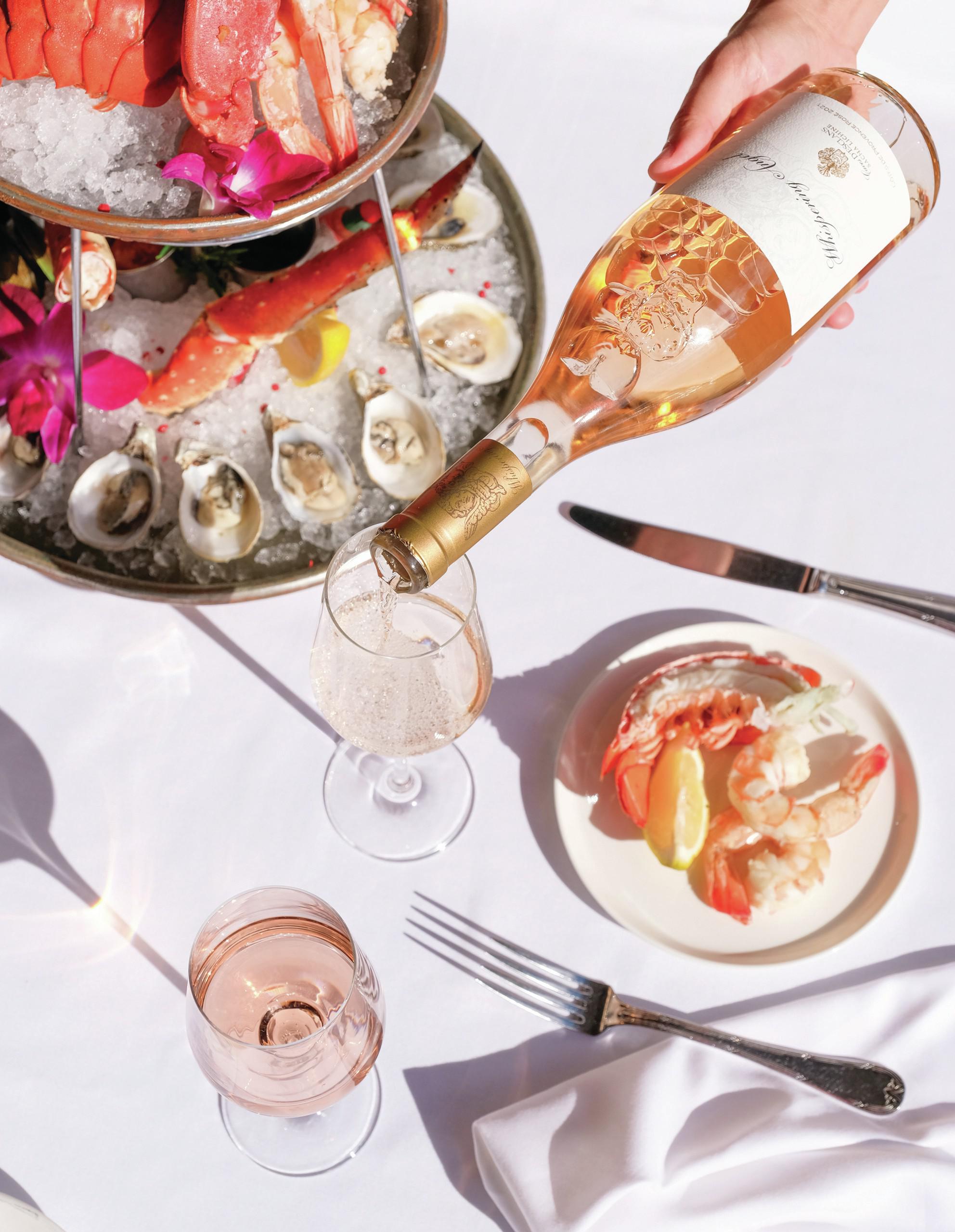
For non-sparkling rosé, however, the education surrounding rosé as a pairing wine remains a work in progress, according to Paul Chevalier, global marketing director for another Moët Hennessy Provence rosé, Whispering Angel made by Château d’Esclans.
“Due to the more approachable, ‘easy-drinking’ taste profile of rosé, we often find ourselves in the more casual dining scene (bistro),” he says. “But, since we produce several ‘special cuvées’ at Château d’Esclans, such as our old-vine Garrus, we are definitely now starting to see more of a presence in Michelin-starred restaurants.”
As rosé diversifies to meet the needs of various cuisines, it’s no longer enough for producers to make only one pink wine. Mirabeau offers a range of pink cuvées, including Etoile and single-estate wine La Reserve – partially oak-aged to open up different food matches – that have secured listings in top-end restaurants. Another Provence rosé producer, Château Léoube, has four styles to suit various different cuisines. “We very much enjoy pairing our premium Secret and Collector rosé wines with dishes such as rack of lamb or veal chops,” says winemaker Romain Ott. “It has been a journey of education introducing both the trade and consumer to our style of premium rosé food pairings. ”
This diverse rosé portfolio approach is one that is being increasingly embraced by producers – and regions – all over the world. France’s IGP Pays d’Oc has seen rosé production soar by 32% over the past 10 years, reaching 1.6 million hectolitres, or 210m bottles, and encompassing 18 grape varieties.
“The democratisation of apéritif dinners, brunches and lighter meals has contributed to the rise in consumption of our rosé wines,” says Florence Barthes, general director of IGP Pays d’Oc. She highlights the range of rosés from the region – from ‘piscine’ wines to high-end products for fine cuisine – and the variety of formats, including low-formality pouches and sealed individual glasses sold in the restaurant cars of TGV trains.
Les Vignobles Foncalieu has a similarly impressive array of pink options, with 14 grape varieties vinified as rosé. Chief winemaker Nathalie Estribeau highlights Château Haut Gléon, an AOP Corbières Grenache/Syrah blend, as offering the kind of complexity and structure needed for Mediterranean or spicy cuisine.
Meanwhile, single-varietal wines, such as Le Versant (Grenache) and Eclat de Soleil (Malbec) – both Pays d’Oc wines – target more everyday consumption. Foncalieu is betting big on rosé: marketing manager Audrey Arino says it accounts for 32% of production now, with a target to market 10m bottles of the pink liquid by 2025. It is, she says, “one of the pillars” of Foncalieu’s strategy.

EXPANDING RANGES
As rosé ranges expand, communicating their distinctive attributes in terms of food pairing is crucial. Domaine Lafage in Roussillon aims to offer “a rosé for each occasion”, says owner/winemaker Jean- Marc Lafage, including Miraflors (“easy to drink, fresh”) with its glass cork; and the partly wood-aged Gallica, with more roundness, structure and minerality.
“We do feel this trend is coming strongly, and we think this could become more and more important among buyers and sommeliers,” says Lafage. “Rosé wines are still very much considered as refreshing and easy to drink, thanks to the Provence style, but complex and richer rosé wines will be dedicated to the next decade, without doubt.”
A négociant model is helpful in covering off a range of styles and flavours. Barton & Guestier markets a Côtes de Provence rosé alongside a rounded and more fruit-forward Pays d’Oc B&G Réserve Rosé (Syrah/Grenache), and a Rosé d’Anjou from the Loire.
The latter, according to the company’s general manager Philippe Marion, lends itself to spicier and more exotic dishes, thanks to its higher residual sugar.
The benchmark of Provence gives the region – and France in general – a head start when it comes to food-friendly rosé, but that’s changing fast. Italian rosé was hardly a byword for quality in the past, says Antonio Ciccarelli, PR and communication manager for the Piccini 1882 Group – but that changed with the emergence of Etna Rosato’s Nerello Mascalese wines a decade or so ago. “The international markets are discovering the ‘renaissance of the Italian rosé’,” he adds. “In several markets, the sales of rosé are growing regularly.” While the US remains driven by seasonality – March to June is peak rosé time – other markets are less restrictive. “We are confident in the future growth of the Asian countries, because of the perfect pairing between Asian fusion cuisine and Italian rosé,” says Ciccarelli.
Meanwhile, Leone de Castris in the Italian south has found the French and US markets productive in the past, but interest is now expanding around the world, and especially to China and Japan. “There is a propensity on the part of international markets to look for particular stylistic characteristics, such as a very light colour, a not too-high alcohol content – between 12% ABV and 13% ABV – and the ability to adapt to the local cuisine,” says owner Piernicola Leone de Castris.
“Our wines, particularly those recently produced, reflect precisely those characteristics,” he says.

There’s a similar dynamic at play in Spain, where Ramón Bilbao makes two contrasting styles: Ramón Bilbao Rosado, a Garnacha-based wine from Rioja, aimed at both quality restaurants and everyday consumption, and the singlevineyard Lalomba Finca Lalinde, fermented in raw concrete tanks, and aged briefly on the lees to aid complexity and longevity.
“With its smaller production and complexity, it is a rosé that is primarily focused on fine dining,” says chief winemaker Rodolfo Bastida. “The idea behind this wine is simple – use the highest-quality fruit to find the purest expression of a rosé.”
Wines such as Finca Lalinde represent a radical rethinking of the prevalent style of the region – a necessity if producers are to successfully target fine dining – and this transformation extends to other parts of the wine world, including South America and South Africa.
In Argentina, Susana Balbo makes two rosés: Crios and Susana Balbo Signature. The former has evolved, says marketing manager Ana Lovaglio Balbo, from a darker saignée wine to something lighter and fresher.
Meanwhile, Signature, launched in 2016 and a 60/40 Malbec/Pinot Noir blend from the Uco Valley, was a pioneer of the Provence style in Argentina. “In the local market, where we do not have much access to imported wine, our Signature Rosé became the wine from the Susana Balbo portfolio that every trendy, highend restaurant in Buenos Aires wants to have, and then this spilled over to the rest of Argentina’s gastronomic scene,” says Lovaglio Balbo.
Meanwhile, Catena Zapata makes three rosés with clearly distinctive styles. One, from native grape Criolla, is “herbal and rich, so it can go with serious food, as in a Michelin starred restaurant”, says Catena Zapata managing director Dr Laura Catena. “The Clarete of Malbec, a darker rosé, is perfect for rich or light foods because it is both mineral and creamy at the same time. “Our new Rosé de la Provincia de Mendoza, arriving in the UK in June via Bibendum, is fresh and crisp, but so elegant I can picture it in anything from casual to very high-end dining.”
Dr Laura Catena expands on this: “Rosé is popular everywhere, all over the Americas and Europe. A rosé can pair with both traditional white-wine foods and with light red wine foods. My grandfather and great-grandfather used to drink a lot of rosé, and there’s a very good reason for that: it’s delicious. It’s here to stay.”
Related news
First 5,000 bottles produced from Pope's vineyard


