



The Big Interview: British Hop Association director Ali Capper
New breeds of British hops could help the country’s brewing industry cut down on its costs and carbon footprint, as Ali Capper, director of the British Hop Association, tells Jessica Mason
In every sphere of the food and drink industry, the importance of food miles and the impact of our carbon footprint is well understood. We know sourcing ingredients closer to home can assist in our nation’s sustainability goals, and also support the local economy. But do enough consumers know which beer styles are brewed with predominantly British hop varieties?
When we buy a beer, is it possible to be conscientious enough to consider not just brewery location but also the distance its ingredients have travelled? In the past, we were spoilt for choice, with shops offering items out of season from further afield, but in the wake of Brexit, inflation and logistics becoming barriers, perhaps we can adapt to have a greater awareness of what we grow ourselves.
Understanding how a small decision made at the bar can have a big impact on our agricultural prosperity, as well as the prices our independent craft brewers have to absorb, could have the potential to influence more informed choices.
Looking stateside for alpha hop dominance or to Europe for something crisp and refreshing will always remain an itch many of us want to scratch. But what if the variety of hop phenols in Britain were to expand due to new hops grafted from foreign relatives? Might we be able to reduce the ecological impact of local brewing, along with reducing the prices?
Indeed, that time is upon us. The dream of making beer in this way is now available. The hops are ready and waiting. Ask Ali Capper, director of the British Hop Association (BHA), hop and fruit farmer, and chair of the breeding programme for British hops at Wye Hops. As she attests, all we really need is to get brewers to experiment with what’s now on their doorstep.
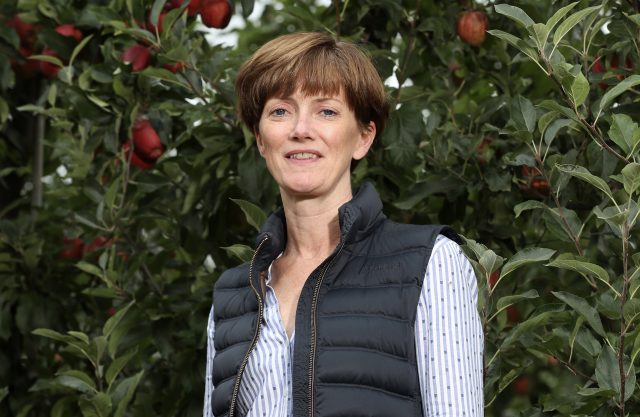
Capper, who is a partner at Stocks Farm on the Herefordshire and Worcestershire border, has had a big impact on the progression of the British beer and brewing scene. Keeping British hops relevant in an ever-fickle beer industry isn’t easy.
Really, all the hipsters have wanted for a long time is something that shouts loudly. This kind of gum-receding bitterness is sometimes called ‘hop creep’, a term used when you can barely taste or appreciate varying beer styles because you’ve raised the IBUs [International Bitterness Units – ascale to gauge the bitterness of beer] – on your core beer to a level of white noise. But we Brits are more reserved, in lots of ways. Sure, we want flavour. But we also want to be able to appreciate nuance. And post-craft, we sought refreshment and a well-attenuated lager, perhaps. Now, we want sessionability and balance.
“Brewers want flavour, impact and something new,” says Capper, who points out that “the innovators are looking to replace New World hops with British ones to reduce their carbon footprint, and reduce their water footprint”. She explains: “We have a wonderful maritime climate here in the UK, and we have ideal hop-growing conditions. Even in a dry year like last year we would irrigate for a lot less of the season than in the US or New Zealand, where it is hotter and drier. Any hop travelling a long distance will carry a higher carbon footprint so buying British hops helps brewers reduce their emissions.”
Capper also highlights how it isn’t just about the carbon footprint, but being conscious of water waste too. She says: “Climate change puts the UK in a good place to grow crops, and we should be growing more here and importing less from water-stressed countries.”
The geographic origins of the hops used in brewing is important because the bitter resins and essential oils inside the hop cone depend on the environmental conditions they were influenced by during their growth. Hops in general have male and female plants, but the part of the plant used in brewing beer – the cone – is from the female. Male plants simply produce pollen, but no flowers or cones. Much like grape varieties, New World hop styles grown in the sunshine are bolder and brighter, with heaps of grapefruit citrus and tropical notes. In Europe, or rather the Old World, and in Great Britain, hops tend to lend more subdued flavours and aromas, but what they lack in fluorescence, they make up for in complexity.
In Great Britain, male hop plants are grown alongside female ones. In many of the breeding programmes, the males are not ‘killed’ but used as parents to develop new female varieties, as well as provide disease resistance in their female hop plant progeny.
But can brewers get out of the habit of thinking that they need to always use American hops to garner attention, especially varieties such as Citra, Mosaic, and Galaxy? Or even NZ hops that pack pine and spicy resinous esters into each brew. Let’s hope so.
According to recent figures from the Society of Independent Brewers (SIBA) there are 1,824 active brewers in the UK. Plus, the BHA says there are at least 32 commercially-available varieties of British hops. But in terms of newness, now there are British varieties that are bred from New World parents, lending something from their naturally borrowed genealogy to their offspring.
Hop plants are perennial, and grow back from the rootstock each year, usually in spring when their shoots emerge. They then begin to grow and climb rapidly on a string framework that is usually supported by a more permanent pole system or wirework. Different hop varieties climb differently, so for ease, some are strung in different patterns to make them easier to harvest, but the diversity illustrates how far things have come from only thinking of one style when it comes to British hops.
As Capper describes: “Challenger is beautiful in a bitter; Goldings in an English pale ale; Phoenix in a porter or stout; Jester in an amber ale; Olicana in a New World pale ale; Harlequin in IPAs.” She points out that the “new varieties of British Hops, like Jester, Olicana, and Harlequin, have amazing flavours – tropical fruits, citrus, passionfruit, mango, peach and pineapple”. These are flavours for which British hops have not previously been known. They are ideal to switch into recipes in place of New World hops for “punchy IPA’s, citrusy beers and pale ales with impact,” says Capper. But as Capper reiterates, it isn’t just the possibilities of the new hop varieties that consumers need to become excited about, but a genuine sense of virtue they will feel about what they can do for their local businesses.
“Hop growers are faced with high wage costs (up by 15%-20% in a year) and super inflation in fuel costs (up 100%-200%), fertiliser (up 400%) and crop protection (up 15%), “ says Capper. “Brewers are also facing huge energy cost increases, as well as packaging and wage cost increases and we are all faced with logistics price rises. Super inflation is hard to mitigate against, and while growers can look at efficiencies and crossquote everything, they do this anyway. What is important is that everyone is paid a fair price for what they are producing.”
“She reveals that, essentially, these past few years have been some of the hardest ever because “Covid struck the industry very hard, and brewers and merchants reneged on contracts”. This meant that “growers have lost significant money three years in a row, and now need contract certainty and prices that reflect the cost of production”. Added to this, “the hop-growing industry has reduced by over 10%, and it is likely to reduce further as growers choose to stop hop farming because the risks are too great”.
If all British brewers investigated British hops, and began adapting their brewing recipes to introduce more beers using the progressive new varieties that share more pronounced New World properties, would there be enough available?
Capper insists: “There will be more than enough to go round. Hop growers need brewers to forecast and provide three- to five-year contracts. Growers can then grow to these contracts, and deliver what is required.” She implores: “Buy British. It’s not just the financial cost of the hops but also the cost to the planet” and adds that brewers, retailers, venue owners, and even the end consumer should start to look for the newest styles, and note who is making this forward step already. And she suggests we all look out for “Jester, Olicana and Harlequin and the numerous experimental varieties that British hop growers are growing for brewers”, especially if we become interested in beers that are going to have an “impact”.
Are there any downsides? It doesn’t sound like it. Perhaps this is the next trend for beer, she observes. “As long as these hops deliver in the beers being brewed they will be here for the future.”
Related news
Sunrise Beverages makes £25K investment into the ICA


