



The Big Interview: Marimar Torres
Having founded her eponymous wine estate in 1986, Marimar Torres is preparing to hand over the reins to her daughter, Cristina. She tells Gabriel Stone about her decades of pioneering work in Sonoma County.

Even the most casual wine drinker in a far-flung corner of the world is likely to have had a Torres encounter. Over five generations, this outward-looking producer has expanded well beyond its Penedès roots, building an export presence in more than 100 markets, supplied by vineyards everywhere from Rioja to Rías Baixas, and even Chile, where the family founded an outpost as far back as 1979.
But this father-to-son Hispanic empire isn’t the only success story worth following. In California’s Sonoma County, wrapped in that famous cooling Pacific fog, lies an equally pioneering Torres venture that is set to see the family’s first mother-daughter transition.
Here Marimar Torres, who planted the original vines at Marimar Estate in 1986, has recently been joined full-time by daughter Cristina. After three years as the company’s director of sales and marketing, 2023 sees Cristina take the helm as general manager.
This may be a family with plenty of experience in handing over the reins, but that doesn’t necessarily make transition any easier. “It’s not,” concedes Marimar Torres, a comforting hand on her two English Springer Spaniels, Bonita and Chico. “I’m trying so hard.”
Alongside this conscious effort not to interfere comes an acceptance that giving up control entirely is hardly part of her genetic inheritance either. “My brother still has some autocratic moments, but that’s OK,” she shrugs indulgently of Miguel A Torres, who remains president of Familia Torres after ceding the general manager role in 2012 to his son, Miguel Torres Maczassek.
Certainly, stepping aside shouldn’t be confused with checking out. “I love what I do; I don’t intend to retire,” Torres insists, only half-joking with the suggestion: “Maybe I’ll just let my daughter do things with my advice.”
PARADOXICAL APPROACH
The ability to take family advice while forging a fiercely independent path is certainly the paradoxical approach that has shaped Marimar Estate since the start.
After two years searching for a property, Torres found herself torn between following the crowd by acquiring an seven-hectare estate in Napa Valley or heading off the beaten track with a 22ha estate in a cool corner of Sonoma. “I called my brother,” she recalls. “He said, ‘Are there any vineyards around?’ I said, ‘No, but it’s very beautiful.’” Beauty triumphed over reason, and Torres found herself at the vanguard of a boom in Sonoma’s wine industry.
Originally the main focus here was Chardonnay, although she planted one third of the original vineyard area with Pinot Noir, not then the obvious proposition that it might seem today. “I’ve always liked Burgundy,” shrugs Torres. “But in those days people were not drinking red wine in the US.”
Once again, her instinct and timing was perfect. A 1991 episode of popular TV show 60 Minutes tackled “The French Paradox”, which set out the theory that despite their love of fatty foods, the French suffered fewer heart attacks than Americans because they drank plenty of red wine.
“Suddenly everyone wanted the Pinot Noir!” Torres recollects. “That’s why I like America,” she adds, drawing a contrast with the far more rigid mentality she experienced growing up in Franco’s Spain. “People here are like sponges; you say something and they absorb it.”
Commercial nous runs in the blood though: any customer wanting a case of Marimar Estate Pinot had to commit to buying two cases of the Chardonnay as well.
Gradually Marimar Estate was able to expand, and with it the volume of Pinot Noir. Today this variety accounts for eight of the 19ha at the original Don Miguel Vineyard in Russian River Valley, and all 8ha planted so far at the estate’s Doña Margarita Vineyard in Freestone Valley, just seven miles from the cooling Pacific Ocean. This significant share of volume is accompanied by prestige: it is the Cristina Pinot Noir that sits at the pinnacle of the estate’s portfolio.
This variety may be big business in Sonoma today, but it’s clear Torres has reached a personal saturation point.
“Now I would not plant Pinot Noir,” she remarks, looking back to another piece of brotherly advice that she not only design the winery in the style of a Catalan farmhouse, but strengthen the link to her roots by planting Spanish grapes. The first attempt was Cava mainstay Parellada, “but it wasn’t very good,” concedes Torres. After persevering for 10 years she pulled it out, a fate also destined for the estate’s Syrah experiment.
“It is very good, but it’s not really what we get inspiration from,” she explains.
Undeterred, in 2004 Torres planted Albariño, but that wasn’t exactly plain sailing either. “Galicia is cold and humid so I planted it in our coldest vineyard, but guess what? After three years it still didn’t ripen,” she reminisces. “Cold and wet in Spain is not the same – it’s much colder here.”
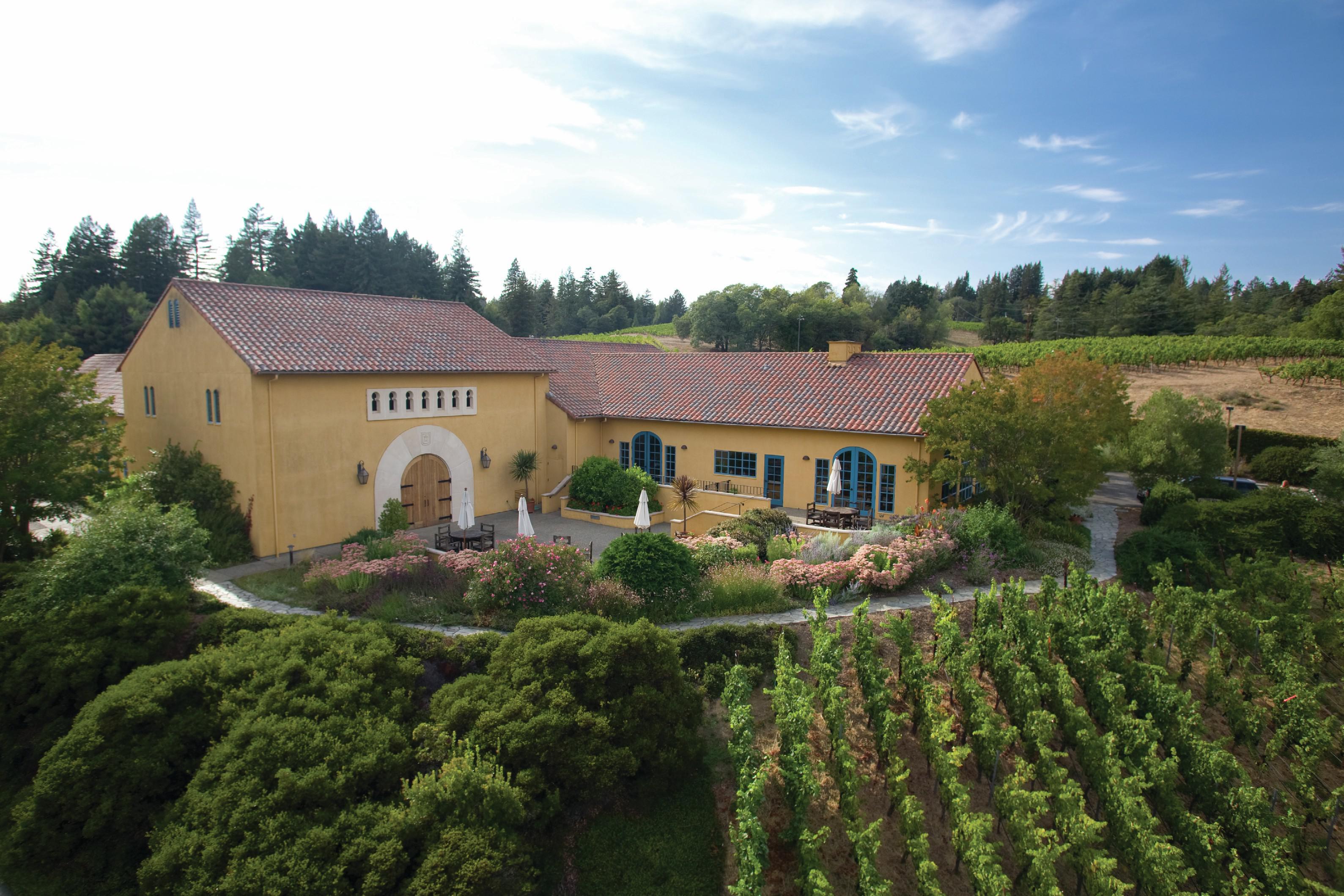
Marimar Estate
It’s not just the climatic differences between Spain and Sonoma that have forced a learning curve. The latter’s soils are generally much younger, with a marked volcanic component. “They’re very vigorous and fertile,” explains Torres, noting the need for high-density planting and summer pruning not just once, as might be the case in Spain, but three or even four times a year.
After replanting her Albariño in the slightly warmer Don Miguel Vineyard, Torres eventually achieved a first successful harvest in 2010. Tempranillo joined the portfolio in 2013, then, in 2020, came a small amount of
Godello, which occupies a single acre here. While these Spanish novelties are a popular cellar-door purchase, they are also starting to venture further afield. November 2022 saw Marimar Estate’s Tempranillo join the Albariño already in the UK, with Godello due to land in time for summer 2023.
How easily have these Spanish interlopers broken into Sonoma’s tightly focused wine scene? After all, Pinot Noir and Chardonnay together today account for almost half the total region’s vineyard area, and an even bigger share of its reputation. “The Tempranillo is very good,” insists Torres, “but it’s not as easy to sell as the Albariño and Godello.”
Drawing a parallel with the style of Tempranillo found in Rioja Alta or higher parts of Ribera del Duero, she observes: “It’s a tannic wine. You have to age it and here people typically want younger wines.” This factor also presents challenges for building critical acclaim. “Most of the press are tasting 2019s right now, but our 2019 Tempranillo is not ready,” acknowledges Torres.
That obstacle might be daunting for another producer, but back in the 1970s and early ’80s Torres was busy building distribution for her family’s Spanish wines at a time when there were almost no US critics at all. “In those days wine was not a big thing,” she notes. “Very few cities had wine critics, but they always had a food critic, so I would get the wines in through them instead.”
It helped that in the early days of this adventure, Torres was herself married to an American wine and restaurant critic, who encouraged her to embrace home cooking in a way that had not been possible back in Spain. “It was not a ladylike thing to do,” she smiles. “I had to make friends with the family cook, and then wait until my parents went out on a trip.”
Suddenly, here she was in the kitchen with US culinary icon Julia Child coming for dinner. “Can you imagine! I made a paella and gazpacho for her, and a dessert, which she was not impressed with.”
This wider gastronomic passion, indeed considerable expertise – Torres has published several books about Spanish and Catalan cuisine – played a formative role in the sort of wines she wanted to make. “I like balance, not fruit bombs,” she explains, “wines that are yummy, that go well with food, not the wines that impress critics.”
With this outlook shaping her decisions, it should come as little surprise that Torres’ next project – a firm signal that retirement is not on the cards – is likely to involve a Spanish grape that has recently started to boast a particularly enthusiastic following among sommeliers. “I want to plant Mencía; it’s so good,” she smiles.
RARE SPANISH VARIETIES
Marimar Estate is also supporting the Torres family’s long-term drive to preserve and promote far rarer Spanish varieties. Moneu, Pirene, and Gonfaus are hardly household names, but are all being given an opportunity to shine in this scenic enclave of Northern California. The challenging hot, dry 2022 harvest meant these “ancestral” grapes were rather sidelined as the team focused all their attention on more commercially significant parts of the crop, but the plan is eventually to select one to join the portfolio.
So, as the Torres baton is prepared to once again pass down to the next generation, there’s no sign of any dip in the energetic momentum that has kept this estate ahead of the crowd. Looking back on the 40-year unfolding of this race, Torres paints a picture that is very much marathon rather than sprint.
“I always think you do things one step at a time,” she remarks. “You put one foot forward and keep going. If it doesn’t work, take a step backwards but don’t give up. The one thing you can’t tell me is ‘you can’t do that.’”
It seems unlikely that she’d be surprised – or even disappointed – if her advice to Marimar Estate’s new general manager meets with precisely the same spirit.
Related news
Driverless tractors to GPS planting: how one New Zealand winery is paving the road to success


