



Why Loire Valley sparkling and red wines should be on your radar
A recent masterclass in London showed why consumers should be turning to the excellent and varied expressions of sparkling and red wines from the Loire Valley, as Louis Thomas discovers.
THE LOIRE Valley is divided into three regions, from the Atlantic coast to the French interior: Nantais, Anjou-Saumur, and Touraine.
This in turn can be broken down into 51 appellations and denominations, with more than 3,600 winegrowers.
In total, per annum, 250 million bottles of Loire Valley wine are sold in France, and 70m are exported (the UK is the second-biggest international market for the region’s wines, after the US).
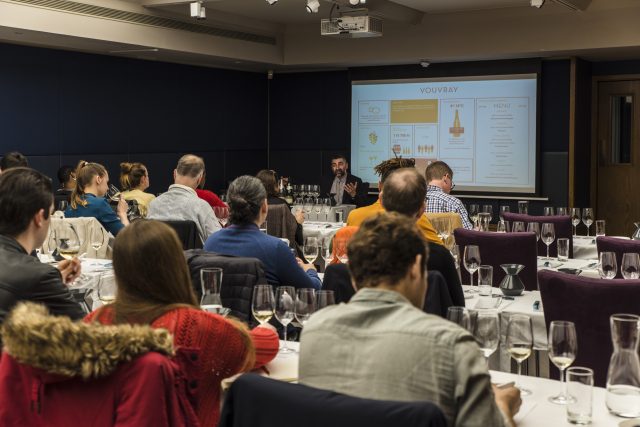
All of these numbers undoubtedly make for impressive reading, but ultimately the diversity and versatility of the Loire Valley’s wines must be tasted to be understood, which is what happened at a recent masterclass in London.
SPARKLING WINES
Roberto Freddi, director of distributor La Mad Wine, and chief sommelier at the Albertine wine bar in Shepherd’s Bush, west London, explained to the class: “When we think of sparklings from the Loire, we think of them as less serious and more fun.” Crémant de Loire is a wine that certainly has a reputation for fun, becoming a popular accompaniment to canapés and small plates at gatherings, as Freddi explained: “For me, it’s the sparkling that I like to drink as an apéritif or with starters. It works very well with fish, shellfish, but also charcuterie. The fruitiness and acidity is superb with rillettes and pâté.”
The Crémant de Loire AOP covers 2,050 hectares, and annual production is around 147,700 hectolitres, or just under 20 million 75 centilitre bottles, according to the five-year average. Though the white varieties of Chenin Blanc, Chardonnay and Orbois dominate, sparkling rosé, made with the addition of red varieties including Cabernet Franc and Cabernet Sauvignon, is also gaining in popularity.
By contrast, the production of Saumur Fines Bulles, south of Saumur, at the midpoint of the region, is somewhat smaller, at 79,000hl, or 11m bottles. Indeed, it is yet to develop the broad appeal of Crémant de Loire, but is still in demand, according to Freddi: “For a long time I struggled to sell the wines of Saumur, people thought they were uncool. I find it appeals to a more niche market,” he said.
But, if consumers were aware of how to get the most of it with a pairing suggestion, that demand could surge. For this, Freddi suggests that it can enhance dishes with a spike of chilli pepper: “Saumur wines work wonderfully with spicy cuisine: Middle Eastern food, or mussels in a spicy sauce, for example”.
Vouvray, in Touraines, typically produces 115,700hl, or just shy of 16m bottles a year. Though its vineyards are dominated by Chenin Blanc, there is a notable stylistic diversity in its sparklings,
as they can range from dry to sweet. With tropical fruit aromas, such as mango, passionfruit, and papaya often present, Freddi suggested that Thai cuisine might be a good match, particularly with the drier wines. The sweet examples, with their high acidity, could equally be a worthy accompaniment to something as rich as foie gras. With that signature acidity lending Vouvray wines a typical ageing potential of over a decade, they will continue to provide something new as they develop.
RED WINES
Making up a majority of red varieties planted in the Loire Valley (56%), Cabernet Franc, also known as Breton by Loire locals, provides the backbone to the region’s red wines. Ripening earlier than Cabernet Sauvignon, it is well suited to the cooler climate, and growing recognition of its suitability for the region has resulted in increased plantings in recent years.
“Cabernet Franc always brings this lively aspect of berries and red fruits,” argued Freddi. Younger examples can even be slightly chilled, and complement delicate poultry, and even fish. Aged examples are more likely to bring aromas of forest floor and leather, and pair well with grilled red meat and dark chocolate.
The four key AOPs for Cabernet Franc wines are, from west to east: Anjou, Anjou Villages Brissac, Saumur Champigny, and Saint-Nicolas-de-Bourgueil.
Production in Anjou and Anjou Villages Brissac is small (7,100hl and 4,800hl respectively), but the quality of wines coming from this area, just south of Angers, from producers such as Ogereau and Domaine de Rochelles, is a testament to the region’s potential.
Saumur Champaigny, by contrast, produces significantly more, with a five-year-average of 80,200hl per annum. However, this is not at the expense of quality, with many of the wines showing an ageing potential of up to two decades.
Saint-Nicolas-de-Bourgueil is home to producers making both red and rosé expressions of Cabernet Franc (with up to 10% of Cabernet Sauvignon permitted in blends), though the latter only constitutes about 1.5% of total production on average. The reds are typically dense, with supple tannins and, thanks to the woodland slopes protecting exposed hillsides from north winds, the grapes are able to fully ripen. The resultant wines have red fruit, violets, liquorice and spice.
CONCLUSION
Ultimately, it is the diversity, quality and affordability of the Loire Valley’s sparkling and red wines that has put the region on the map, with its winemakers getting the most out of two varieties in particular: Chenin Blanc and Cabernet Franc. Though certain styles are still yet to appear on consumers’ radars in the UK, it is only a matter of time before they do.
To discover more, visit: loirevalleywine.com
Related news
Cono Sur shows off terroir-led range
Historic Polish vodka distillery heads to auction with £53m redevelopment potential


