



The Big Interview: Elena Carretero
For Elena Carretero, sustainability director of Santa Rita Estates, caring for communities is every bit as important as nurturing soils, finds Sarah Neish.
Pushing open the heavy wooden doors of a chapel squirrelled away amid fragrant magnolia and almond trees in Santa Rita Estates’ lush Centenario Park, a curtain of silence falls. Standing on the threshold it’s easy to imagine all those who have perched in the wooden pews during the past 137 years, staring up at the richly painted frescoes, and pondering where life would take them in the coming years.
Outside of these walls, Chile has seen civil war rage, economic depression descend, and furious earthquakes carve up the country, but inside this place of sanctuary, candles have always been lit, and quiet prayers muttered, regardless of what has unfolded without.
The historic importance of buildings such as these is one of the first things that struck Elena Carretero when she was approached to work with Santa Rita Estates (SRE).
“I fell in love with the place,” she says. “The conservation and restoration of the heritage buildings, including the chapel (declared of historical importance to Chile in 1972) and of the vineyards were amazing. I have still to this day never been to such a place, in private hands, with this level of conservation.”
Brought on board in 2011 to spearhead an ambitious new sustainability programme, which would come to underpin everything that SRE does, Carretero took to her task with something approaching religious zeal. At the top of her list was ensuring that those who lived and worked in Santa Rita’s wine estates and their surrounding communities would be able to continue enjoying its historical significance for years to come.
“I saw the role as a unique opportunity to build the image of Santa Rita based on its culture and heritage,” Carretero says. “At the beginning, 11 years ago, it was not easy because Chile considered everything historical to be ‘old fashioned’, and everyone wanted to build something new and modern. But I presented a proposal combining both tradition and modernity, and proving that this hybrid model could be successful.”
This marriage of past, present, and future fitted perfectly with the notion of sustainability; a nuance that is far from lost on Carretero.
“I think we have a huge responsibility, not only at SRE but within the broader wine industry, to emphasise the value of wine culture,” she says. “I do feel pressure because I’m compelled to educate people on this centuries-old tradition that is starting to be lost, even in areas that have been producing wine for a long time. For me wine is culture. It has been in the history of humanity since 5,000 BC, and has developed economic activity in a lot of territories.”
The idea of the cultural value of winemaking gradually disappearing is linked to a creeping urbanisation, and the fact that many children whose parents and grandparents have picked grapes and made wine for SRE and other producers, are increasingly tempted by the bright lights of big cities, where unpredictable weather and powdery mildew are low down on their list of concerns. “As a planet we are facing a very fast change in terms of rural environments morphing into urban ones,” says Carretero.“This is largely due to land use change, housing development, and things like these. At SRE, we want to enhance the rural identity of Chile, and show young people that the wine industry, and services related to wine tourism, is a real option to grow in professional terms.”
Very often when businesses talk about sustainability, the emphasis is placed on the land itself, and on climate change in particular. But SRE stands out for putting people first. Human beings, Carretero believes, are the key to unlocking a more sustainable future. Rather than focusing on the soils, it’s more about faces. It all starts with them.
“Being part of the agriculture world provides that special link with the land we are in, and people, of course, are a big part of this,” she says. “SRE has always had a unique and specific focus on family. We don’t see our workers as single units, but as part of something bigger.”
Up until the 1960s, SRE had more than 60 families living inside its winery in Alto Jahuel, nestled in the foothills of the Andes. The main wine estate included houses, a maternity ward, a school, and even a theatre. “Some of our current colleagues were born here, and continue to be part of our family, so we appreciate and value this as part of our style as a company,” says Carretero.
To this end, Carretero has been instrumental in developing what she calls SRE’s ‘Territorial Valorization’ programme. Essentially, it’s about fostering a sense of pride in the area in which children live, in the hope of inspiring the next generation of winemakers, rather than losing them to office jobs in big cities far from the land they grew up on. The premise is to get kids fired up about how they can get involved in the wine industry, whether that’s through working in the vineyards or welcoming visitors via hospitality and oenotourism, an area in which SRE is blazing a trail. The wine group recently achieved “outstanding”status in wine tourism, as part of its Chilean Wine Sustainability Code certification.
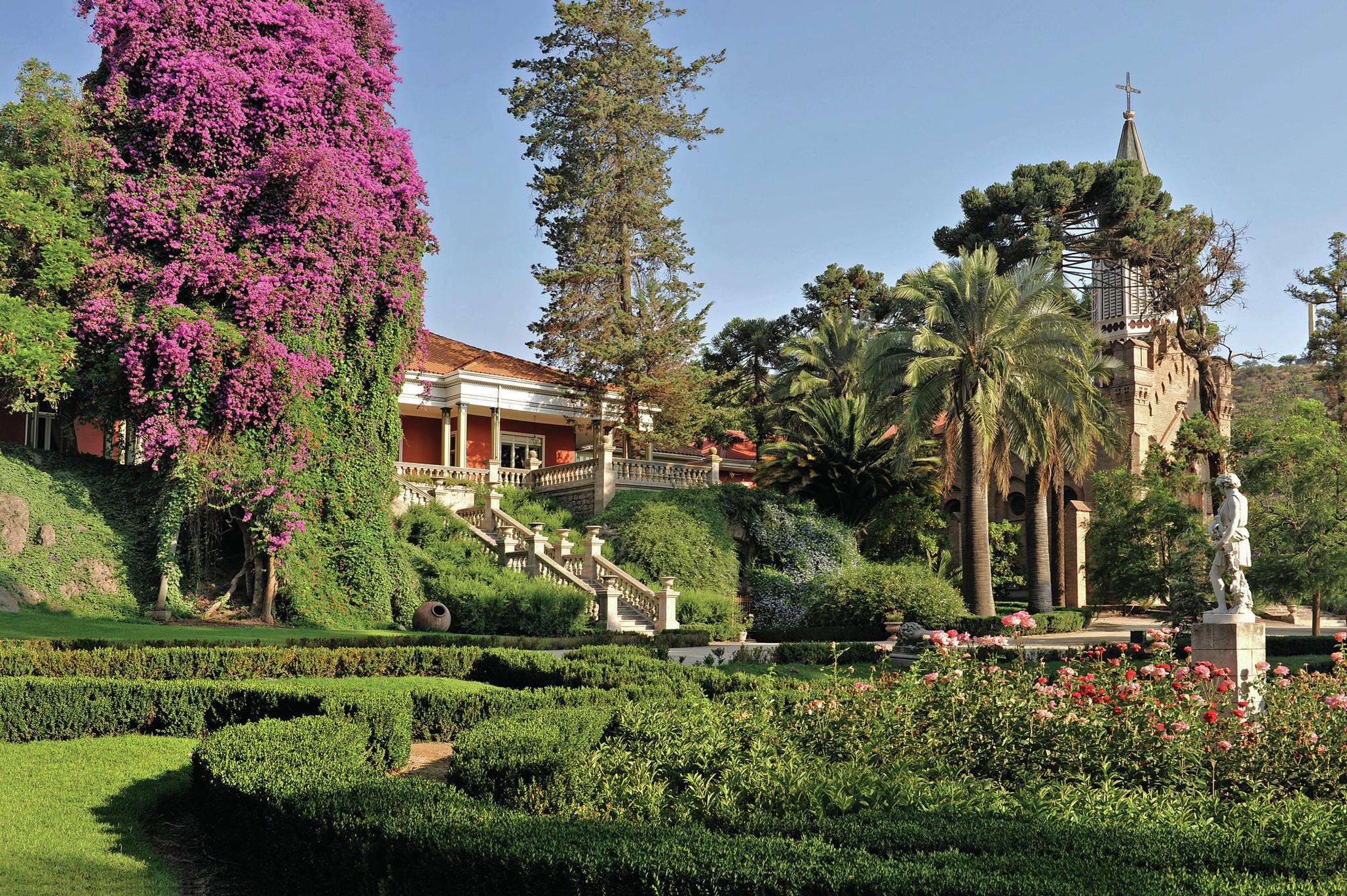
Park life: the lush Centenario Park on Viña Santa Rita’s Buin estate
“Territorial valorization is the process of assigning value to the identity of a region, and to the cultural, historical and natural aspects of that place, as well as to any economic activity that is special to that area, such as winemaking,” says Carretero. “I firmly believe that what we don’t know about we don’t value. And what we don’t value we don’t take care of. It’s why we designed this programme to educate children about their own territory; to create a sense of pride in it.”
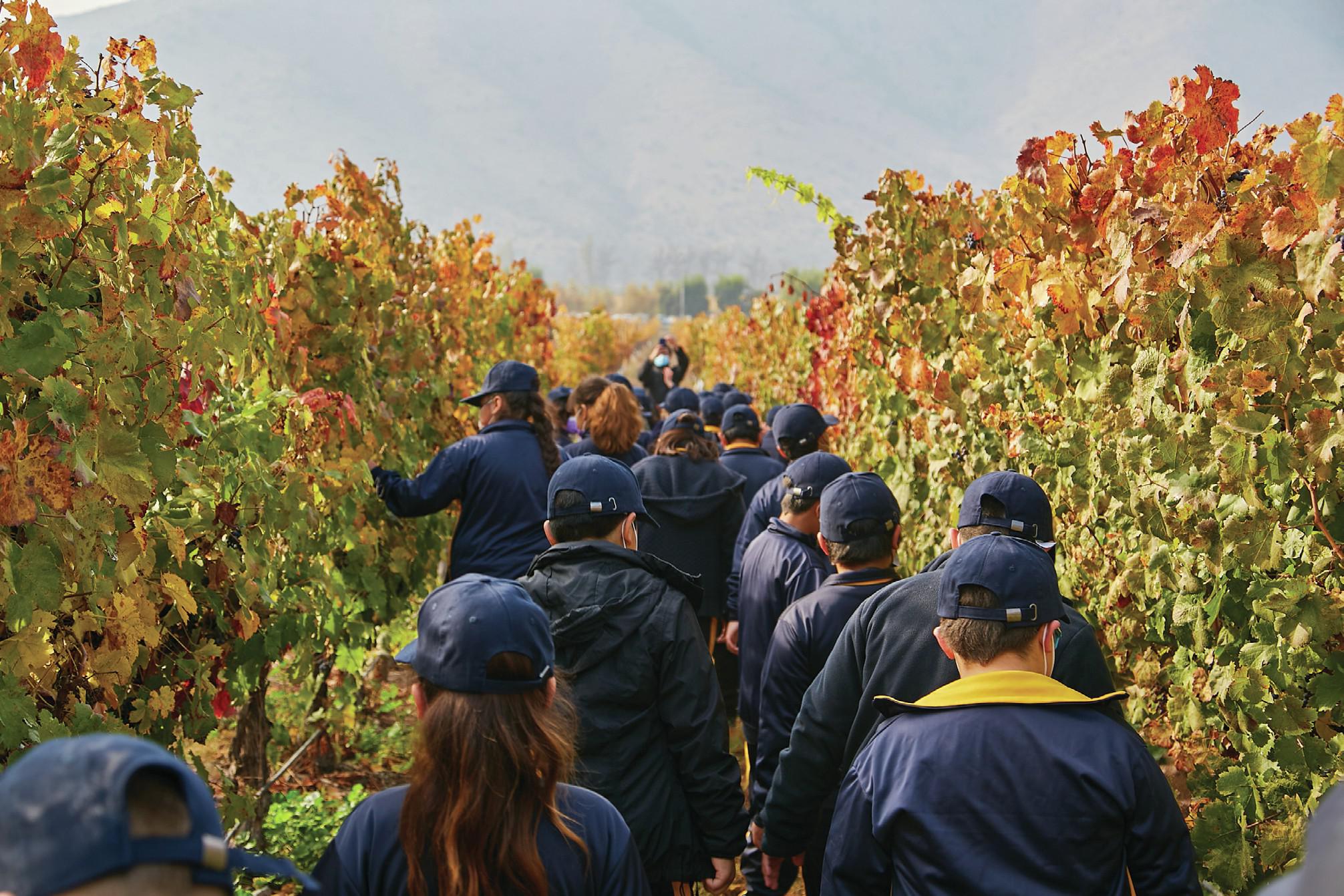
For the past 10 years SRE has worked with neighbouring schools to incorporate aspects of wine culture into their curriculums. Workshops, facilitated by SRE, take place in the classroom, and local students are also invited to take part in the harvest at the winery.
“It’s one of my favourite moments of the year,” says Carretero. “The students visit the vineyard to harvest and crush grapes to obtain the must, which is then bottled. You can’t imagine the happiness of that moment, when they are working as team, smashing the grapes with their feet. At the end they do a presentation for their school showing all the different things they have learned.”
One of the many meaningful goals Carretero wanted to achieve with the project was for children to have the chance to put themselves in the shoes of their parents, many of whom have worked with SRE for decades. “The kids start to become aware of the value of winemaking, and they begin to realise the importance of their region – the Maipo Valley – which is visited by around 160,000 tourists per year.”
Inside the classroom, SRE’s team tirelessly helps teachers convey the history of winemaking, from the earliest references, dating back to Georgia in 5,000 BC, all the way through to modern-day winemaking in Maipo. “The students even study winemaking in language, looking at texts and poetry related to wine,” says Carretero. “It’s been challenging to adapt our concepts in an easy and fun way to connect with our young audience.”
Rather touchingly, whether or not students decide to enter the world of wine professionally or not, SRE is there to help and advise them on their next steps in terms of career path.
“For the past seven years, we have delivered more than 90 scholarships to our people, worth around CLP$160 million (£150,000),” Carretero explains. “Also, with the aim of supporting the children of our colleagues, we subscribed in 2018 to the Fundación por una Carrera (Foundation for a Career), which helps students to evaluate their skills when choosing undergraduate studies, and guide them in the wide range of benefits they can apply for.”
Of course, there is little use engaging with communities if the neighbourhoods in question are unreceptive to the ideas being proffered. At SRE, community feeling is meticulously measured and monitored so the sustainability team can gauge the impact their work is having.
“We really believe that we must have the data and numbers to track the performance of every initiative we are working on,” says Carretero. “These have turned up some quite interesting results.”
In 2017, the wine group instigated a Social Impact Measurement Study to look into how its educational programmes were perceived in the Alto Jahuel area. What Carretero learned was that while Territorial Valorization generated a high sense of belonging and attachment among students to the Maipo Valley in the short term, by the time they had reached the second grade in high school, this had declined. So SRE leapt into action, adding a second phase to its school initiative, which it hopes will keep students engaged.
“It was implemented as a 2.0 version, putting our focus on entrepreneurial skills, and preparing students to decide what to study in the future,” says Carretero, who is pleased with how the programme is progressing.
However, she is a firm believer that not all learning takes place in the classroom. In 2011, SRE established a series of live classical music concerts, which are free for local pupils and members of the public to attend. Called the Seasons Concert Cycle, these events see internationally acclaimed artists and orchestras perform in the winery’s atmospheric surroundings, including in its beautiful chapel, which boasts stunning acoustics.
In June, SRE received 300 students from schools in Maipo to listen to Spanish musician Jordi Savall perform with orchestra Le Concert des Nations, which plays with period instruments. The next Seasons concert is due to take place at the end of September.
“We could do the concerts only for a private audience but why not share this moment?” asks Carretero.
Aside from education, Carretero is just as passionate about supporting the wellbeing of SRE employees. The firm has a medical centre at its main estate, which provides free care to employees and their families in areas such as pediatrics, gynaecology, nutrition, dentistry, psychology, and general first aid. “It’s an important contribution to the family budget,” says Carretero. “We also have a welfare fund, where we reimburse any medical expenses that are not covered by the public or private health systems.”
SRE, which encompasses the Carmen, Sur Andino, and Doña Paula brands, spans such a wide arc of regions in Chile that assessing the needs of individual communities can be challenging.
It’s why Carretero has invited a figurehead from each area to communicate its needs to the company so that the wine group can offer better support, she says.
However, with brands jostling for sustainable credentials, and consumers increasingly aware of greenwashing, does Carretero think fatigue is setting in for the word ‘sustainability’? Do we need a new term to take us into the future?
“I’m absolutely in favour of continuing to use the term,” she says. “It was defined by the scientific community in 1987 when the Brundtland Convention defined sustainability as something that satisfies the needs of present generations without compromising the needs of future ones. Sustainability is the convergence of being environmentally friendly, economically viable, and socially equitable. You have to have all three or you will vanish.”
She does, however, recognise a need to be clearer around the language used. “I do think we need to educate the consumer that being ‘green’ is not necessarily the same as being sustainable. Organic and biodynamic only cover one part of the environmental chapter, but organisations may not be taking care of the social aspect,”she says.
“I strongly believe that companies can make a positive impact on communities. Sustainability is a direction, not a destination, and any contribution towards this counts.”
Elena Carretero at a glance
Carretero began her career as a negotiator of Free Trade Agreements in the Ministry of Foreign Affairs of Chile, with a particular focus on wine and spirits. Following this, she was instrumental in creating a consortium between Chilean wineries and local universities for the purpose of furthering R&D for the wine industry. Part of this involved designing a comprehensive sustainability programme. In 2011 Carretero joined Santa Rita Estates as corporate affairs and sustainability director. She remains on the board of the consortium for R&D and sustainability of Wines of Chile today.
Related news
Master Winemaker 100: Cynthia Ortiz
Château du Tertre partners with Ulysse Cazabonne to launch 'iconoclastic' white blend


