



Sales force: the changing landscape of UK drinks retail
With e-commerce seeing a slight cooling since the height of the pandemic and shoppers returning to store, what is the new normal in drinks retailing? How are retailers navigating the changes and new challenges, and where do they go from here? Arabella Mileham investigates
2022 is shaping up to be something of a crunch point for wine retail. It has weathered all that the pandemic threw at it, from the explosion of e-commerce to Covid-related shipping and logistics issues, survived poor harvests (in New Zealand and France in particular) and subsequent shortages, as well as enduring the red tape, import delays and exchange rate problems associated with Brexit.
But just as a new normal should be being established, another round of challenges emerges in the form of spiralling inflation, which is set to affect consumers’ behaviour.
So what is the new normal in drinks retailing, and how are retailers navigating the changes? Indeed, where do they go from here, and how is retailing changing to meet this perfect storm of challenges?
According to Richard Halstead, chief operating officer, Consumer Insights at IWSR Drinks Market Analysis, a key hurdle for retailers in 2021-22 has been getting people back into stores, and resuming patterns of behaviour that had been disrupted by Covid. He points out that basket value was quite high in the second half of 2021, which retailers attributed to the post-Covid bounce-back and people having money that would otherwise have been spent on holidays and going out.
“One of the biggest challenges was last Christmas, where demand for premium products was very high, and there were struggles to keep stock on shelves, especially prestige items like Champagne and higher value wine brands,” he says.
Simon Cairns, BWS boss at Co-op, admits to losing sleep over stock not coming in – for example, goods arriving in March that were due in December. And although shipping issues are now easing, he notes, that may be because retailers are planning earlier to take logistical vagaries into account.
“We adjusted our systems so that it takes into account that what used to arrive in seven weeks now takes 14,” he says. “But it’s not the way supply chains are designed to work. As an industry we have to think whether this is a long-term enough issue to rethink our attitudes to stock and availability, or are we confident that we’ve ordered within a realistic timeframe?”
Tesco’s wine category buying manager, Pete Bexton, also cites availability issues as the team’s greatest concern over the past year. Staff had to work hard to navigate these complications.
“We pack some of our wine products in the UK, importing it in bulk, which is great from an environmental perspective, and helps with availability, as stock held in the UK is more accessible,” he says. “We also started using trains to transport wines from the EU and across the UK, which has not only helped with haulage, but is also much more sustainable, as it reduces our reliance on lorries.”
Majestic CEO John Colley argues that this underlines the need for retailers to be agile and prepared, to cope with myriad issues, from new stock lead times, to difficult harvests and energy-cost rises.
“I think we’ve done a very good job in adapting to the ‘new normal’, with planning taking place earlier than ever, and additional warehousing and infrastructure being put in place to keep the wine flowing,” he says.
RISING COSTS
But looking forward, the big concern is undoubtedly rising costs. “There’s clearly a lot of pressure right now,” says Colley. “Not just for us, but for our colleagues and suppliers too. While we have to be mindful of those pressures, we have to continue to put our customers first too,” he says.
We’ve already seen spiralling fuel and transport costs, the relentless rise of the cost of raw materials, inflation reaching a 40-year high of 9.4% in the year to June 2022, and interest rates that are expected to reach 3% by Christmas. And that’s without the summer of political limbo as the country waits to find out who will hold the keys to number 10 (and number 11) Downing Street in September, and the policies they will adopt.
While consumer behaviour may not have started to change just yet, Halstead notes that the biggest worry for retailers for the next six months is how consumers will cope with falling incomes in tandem with rising bills.
In the 12 weeks to 11 July, total alcohol sales in the grocery channel fell by 11.6%, according to Kantar data, with branded products falling faster than private label (a drop of 12.5% compared with 9.3%) with still wine falling by 10.3%, and sparkling by 11.1%.
“The biggest puzzle is around which discretionary purchases will be discarded and which will endure,” Halstead explains.
“Our research during Covid suggested that consumers were very happy to transition their budgets from on-trade to off-trade and treat themselves more at home – and this may yet happen again, for a certain segment of the population who are more insulated against cost-of-living squeezes. For others, however, it will be a more difficult trade-off.”
The biggest opportunity is for retailers to understand who is likely to trade down, whose spend is likely to be more resilient, and which categories are going to be better or worse off as a result, Halstead points out.
Speaking to the drinks business at a recent tasting, Sainsbury’s technical manager and winemaker Lisa Rogerson acknowledged that this collision of rising costs meant retailers were already finding products more expensive to buy.
Potential changes to the way in which duty is calculated is also on the horizon – although in mid-July it was announced that the government’s alcohol-duty review would be postponed until the autumn. Nevertheless, there are a lot of wines on supermarket shelves that would fall under this bracket, notably higheralcohol reds, adding significantly to retailer expenses.
It is therefore no wonder that the Sainsbury’s team is highlighting its entry-level House range, which retails for around £5, arguing that it is important for customers to have “a decent range at a range of prices, so if someone does want to buy something slightly cheaper than they were before, they can”, Rogerson said.
“We have a Hungarian Pinot Grigio that has more richness than an Italian Pinot Grigio, our House Pinot Noir is a light, fresh fruity Chilean, and our Caminada Malbec is a big, bold Argentinian style, with no oak,” she added.
‘Consumers today recognise value differently than they did 10 years ago, so we need to make sure our range is broad enough to offer quality and price points for every customer ’
But value isn’t just about price, Majestic’s Colley argues. As well as introducing customers to new regions that offer quality at a lower price or helping them buy different styles or grapes – “South African fizz, for instance is currently flying for us,” he says – customers need more education about what real value in wine is.
“If you spend £8 to £10, for instance, you get such better quality because of the way duty is calculated,” he says.
As a result, he is confident that the shift towards potentially drinking less, but better – which was seen in the pandemic – is here to stay.
MARKET DIVERGENCE
Tesco’s Bexton agrees that while it is still too early to give a definitive picture of how customer behaviour is changing, there is evidence of divergence in the retail market. “We have seen some very early signs that customers are trading down on wine, but we are also seeing signs that they are enjoying in-home occasions, which means choosing a wine they love to make it special,” he explains.
This has given retailers greater scope to look at more interesting wines that perhaps would normally be seen on a restaurant wine list. It highlights that while offering value is important, value is not just about offering products at the lowest price.
“It’s about getting the quality-to-price ratio just right, to make sure that there’s a great-value option for every level,” he explains. “Consumers today recognise value differently than they did 10 years ago, so we need to make sure our range is broad enough to offer quality and price points for every customer.
“In addition, many consumers are now looking for products with environmental credentials, such as sustainable packaging. It’s important that we get the balance right between value and the best practices.”
But what of retail’s big winner of the last pandemic – e-commerce?
Retailers agree that while the shift to e-commerce is here to stay, as people simply incorporate deliveries into their routine, it has inevitably slowed since the peaks seen during the pandemic.
There is still scope for improvement, and this is increasingly a focus for retail teams. For example, Bexton argues that Tesco is making strides in terms of improving its online service. “We have more choice and availability than we did in 2020, and we’ve also launched Whoosh, our super-fast delivery service, with delivery in less than 60 minutes,” he said. “Immediacy is hugely important, and beers, wines and spirits play a big part in immediate shopping missions,” he argues.
Already available from 200 shops, Whoosh will be rolled out from a further 400 by the end of next year.
Partner Content


Erin Smith, digital marketing director of e-commerce site Slurp (a subsidiary of Freixenet Copestick), argues that the pertinent question is less about whether e-commerce levels have gone back to prepandemic levels and more about where they go from here.
“It’s what we’re doing with that customer base now that’s actually important,” she told a panel at the
‘There’s a lot more consumption of wine and, particularly, spirits, in ways that would have been exclusively done in on-trade settings, but consumers have discovered them at home’
London Wine Fair. “We’re not just competing with other online retailers, we’re actually competing now with convenience in a way that we weren’t necessarily before, as well as with the ontrade,” she said.
Speaking on the same panel, Richard Weaver, director of digital and retail at The Great Wine Co., also noted that the way people approach drinking at home has changed from an experience point of view. “There’s a lot more consumption of wine and, particularly, spirits, in ways that would have been exclusively done in on-trade settings, but consumers have discovered them at home,” he said.
“They are carrying on doing that even now that the on-trade is back, as we’re bang in the middle of a cost-of-living crisis which makes it a more expensive challenge for consumers in restaurants and bars, so that has probably helped to prolong that trend.”
This proliferation of occasions, and the number of suppliers upping their digital offerings, has increased the competition, agreed panel member Tom Harvey, of marketing agency YesMore Drinks.
“Some customers will have found their retailer or online retailer and stuck with them, but some will still be shopping around,” he argued. “We’re in this point post-pandemic now, where if you haven’t already secured the loyalty of your consumer, now’s the time to do that.”
The key to securing loyalty, the panel suggested, was not so much fancy tools and tactics (although these might help streamline and digitise some processes) but getting to know your customers, and crucially, spending time working out who that target customer is. “What’s the message that’s going to resonate with them, before we start saying, ‘Well, what tactics are we going to use to attract them’?” Harvey asked.
OMNICHANNEL GOALS
One of the key takeaways from the London Wine Fair discussion was that drinks retailers shouldn’t be talking about e-commerce as a separate, unique category, but as two sides of one coin.
Panel member Simon Huntington, the former commercial director for Roberson Wine, who co-founded Vintegrate Marketing in December 2021, pointed out: “It’s not online retail, it’s just retail. Fundamentally, customers don’t think of themselves as being e- commerce customers, or offline, as IRL or URL. They just think of themselves as being customers.”
This idea of omnichannel, or as Colley puts it, “being channel-blind”, is where many feel the retail landscape is heading. “It means that whether you’re shopping online, in-store, through Deliveroo or click and collect – you still get that same Majestic experience,” Colley explains.“Where the actual split happens is less relevant.”
Meeting the consumer where they are – whether that is through delivery apps like Tesco’s Whoosh or popular apps like Vivino is key, Bexton agrees. “It’s an exciting time for the industry, as we need to adapt and reflect how consumers interact with us,” he says. “It’s important to evolve so consumers can engage with us the way they want to and also to reflect how businesses are working these days.”
If the pandemic has proved anything, it is that people want human connection, argued Anne Jones, who works in drinks experience and development at Waitrose. The point where digital fell down during the crisis was where this interaction was not possible. “People were OK to just buy things, but as soon as they wanted to get any more engaged, that connection between digital and physical was lost,” she explained at a London Wine Fair panel session.
‘The future I’d like to see in 10 years’ time is a hybrid where you can walk into a bar or a shop and be connected both digitally and to an actual person who can answer your questions’
“Where we started to see the thing become really successful was when we used real-life experts. We took our store experts who potentially were not getting the exposure they needed, to back up webinars, answer Q&As, and host suppliers. Then suddenly that personality and creativity started to come through, having added in those extra touch points, whether they be a digital promotion, or online content,” she said.
The question then becomes how to develop and build on that relationship, and keep it going when it moves back into the physical realm.
So far, we haven’t yet reached the point where a customer can stand in a shop and look at their phone and those two experiences are integrated, Jones said, whether through GPS, near-field communication, or connecting with products themselves, and convert those interactions into transactions. That is the ideal and ultimate goal of omnichannel.
“The future I’d like to see in 10 years’ time is a hybrid where you can walk into a bar or a shop and be connected both digitally and to an actual person who can answer your questions,” she said.
However this may require not only a total change of mindset, but potentially a reorganisation of retail businesses.
As Jones pointed out, one of the challenges for bigger retailers in particular is that their digital and physical channels are often run as separate business units. “That does not lead well to an omnichannel solution,” she added.
INDIES’ ADVANTAGE
Smaller and potentially more agile online and independent players may have an advantage in that regard – and technology will play a key part, according to Vagabond’s co-founder and executive director Stephen Finch.
The dream, he said at LWF, is for wine retailers to become “the Spotify for wine… by leveraging technology to enhance the real-world experience”.
“Wine has so much in common with things like music and video content on Spotify or Netflix – there’s a massive inventory of titles and SKUs and a lot of data points for each one. And it is really hard for the average person to make sense of all that stuff,” he explained.
“I very happily give Spotify my personal data because in return they introduce me to songs that I otherwise wouldn’t have come across, that I love. So it’s a really good relationship.And wine is inherently great for that kind of relationship as well.”
But behind this lies the sometimes elusive data that can be gathered from customer interactions and transactions, which is becoming an even more important part of every retailer ’s arsenal.
For Slurp, it is essential to building campaigns that resonate with customers.
“Data is going to become an essential part of driving success,” Erin Smith argued at LWF. “It will help you get more loyalty out of that customer base once you acquire them, by making sure that you’re building campaigns that actually resonate with your customers, making sure that we’re actually getting the try to get them to trade up.”
‘Not everybody is having a party, not everybody is drinking this evening, and understanding that is really important. One size doesn’t fit all – and prices aren’t the only driver anymore’
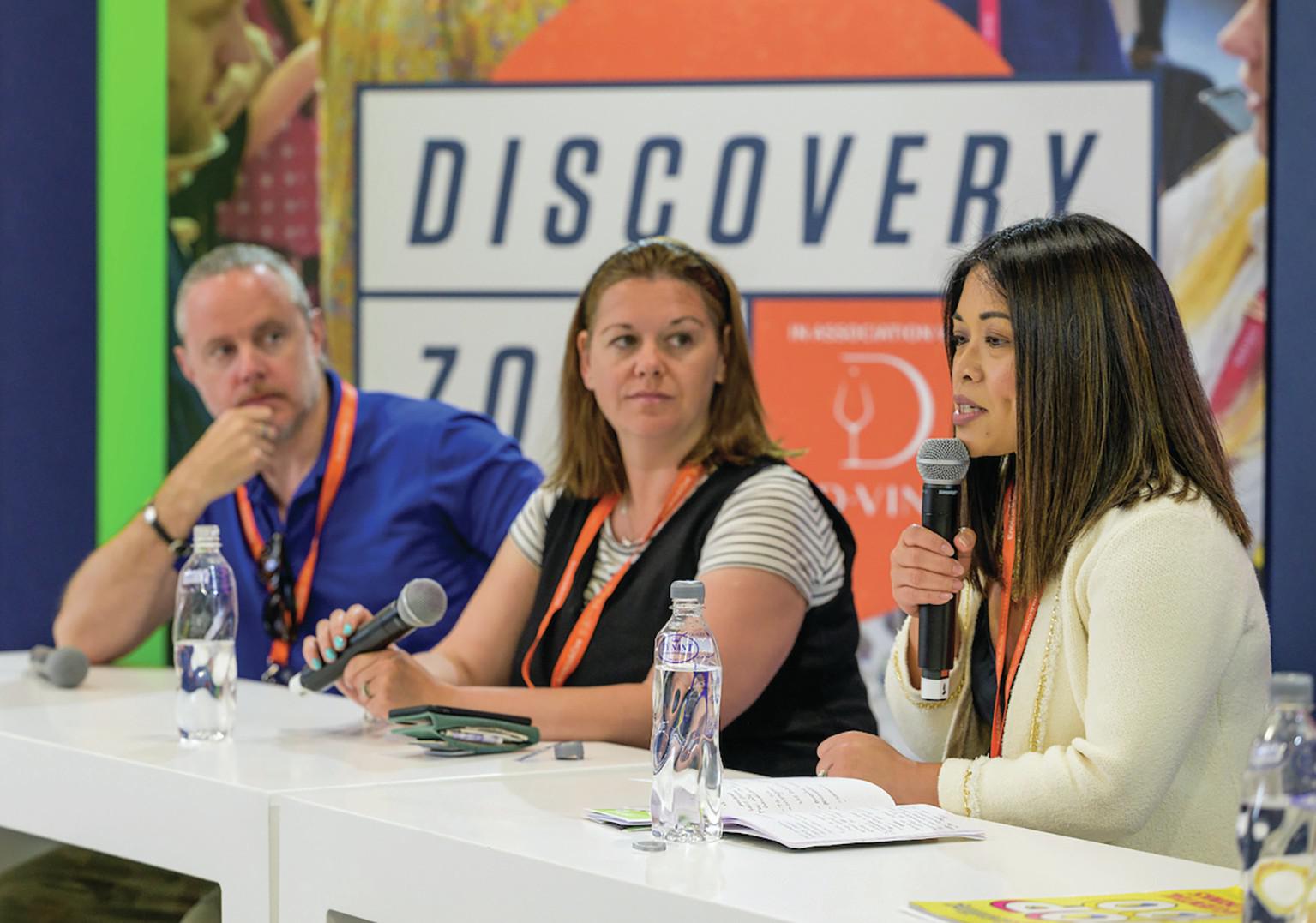
Panel beating: Stephen Finch, Anne Jones, and Herchelle Perez Terrado
For the industry as a whole, attracting consumers is no longer just about showing the bottle of wine or having a sommelier or producer talking about the terroir or the pH of the soil, it’s more about tapping into something that people are already interested in, or the occasion in which they might want to consume that product.
“Connecting with the consumer is all about location; what location they are in, and what their mission is,” Herchelle Perez Terrado, founder of consultancy firm Drinks Partnership, noted at a LWF session. It’s about creating a shopping platform that taps into the consumer ’s mission. Not everybody is having a party, not everybody is drinking this evening, and understanding that is really important. One size doesn’t fit all – and prices aren’t the only driver anymore.”
With all this in the mix, there’s no hiding from the fact that it is a complex time for retailers at the moment. While building a relationship with the customer is clearly key, so too is strengthening relationships within the business itself, particularly with the logistics and imports teams, and with the company’s suppliers.
As Georgina Haughton, Sainsbury’s head of wine buying, said: “Buyers are now supply-chain experts too. Working with suppliers has been essential to enable us to plan far in advance. It used to be more antagonistic, but now it’s become more about building and nurturing those relationships.”
With the cost of living crisis showing no signs of abating, these crucial relationships are going to be key in ensuring that retailers thrive.
Related news
VIK 2022: ‘the beginning of a journey toward self-sufficiency’


