



The big interview: Moët’s UK MD Alexei Rosin
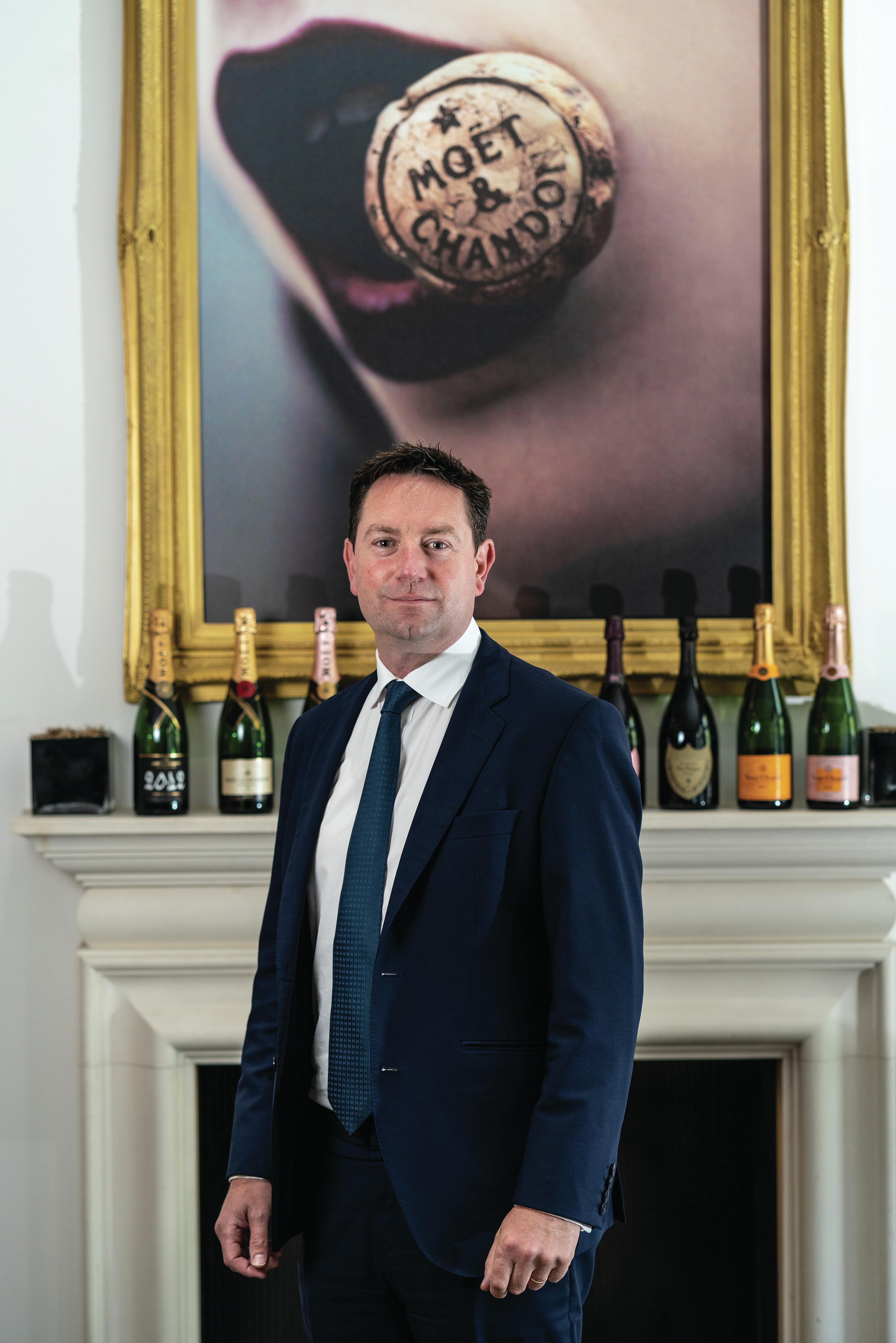
IT’S DOUBTLESS thanks to his calm manner and extensive experience that Alexei Rosin was asked to lead the UK market for Moët Hennessy early on in the Covid-19 pandemic.
Taking up the post of managing director for the luxury drinks group in May 2020, he was given a position of power at a time when top-end drinks, and particularly Champagne, were being hard hit. Indeed, it was around this time that the famous French fizz was being projected to see a year-end sales decline totalling 100 million bottles, representing one third of its annual business. Considering that Moët Hennessy produces around a quarter of the region’s entire Champagne volumes, it would take an unflappable personality to step into such a senior position at this time. Not only that, but one who’s worked in the UK drinks scene for long enough to witness the good times and bad.
RISES AND FALLS
Starting his career at Moët Hennessy as a London sales manager in 1999, Rosin has worked in a range of roles at the group for more than 20 years, most of them in the UK, although he spent a two-year stint in New York managing the company’s on-premise business across the US. As a result, he’s been involved in the Champagne sector long enough to see some major rises and falls in the product’s fortunes, and from positions in two of the category’s leading export markets.
As for his personality, based on Zoombased encounters with the drinks business, while Rosin initially appears reserved, he is keen to share his views on a range of subjects, both related to his company’s brands, and the wider drinks industry.
Indeed, in July, he joined the board of the UK’s Wine and Spirit Trade Association –a sign he wants to be part of a community of influential figures in the market – while he has expressed a willingness to db to be contacted for comment on a range of issues such as consumption trends and sustainable wine production, not just for news specifically related to Moët Hennessy brands.
He’s a straight talker too. At the start of our last conversation earlier this year, he described the Champagne business over the past 18 months as a “rollercoaster ride” before stating, “2020 Champagne volumes were not good at all across the whole category”.
Pointing out that the UK on-trade Champagne sales were down by 60%, he added that the total trade dropped by 22%, which, he said, “was the worst performance for the category since the ’91 financial recession”. And he admitted that Moët brands were “severely impacted, given the closure of hospitality”.
Having said that, due to the strong performance of Moët & Chandon and Veuve Clicquot in mass retail, which was “better than originally anticipated”, the group’s Champagne business suffered a “single-digit decline” in 2020 in volume terms, as the group managed to “pivot business from the on-premise to off”.
As for this year, explaining his rollercoaster analogy, the picture has “been very different”, with “an incredibly strong start”, with Nielsen figures showing Champagne sales increasing by 70% compared with 2020, and 30% compared with the more normal trading situation of 2019. The growth is also favouring Champagne’s historic brands – grandes marques – which represent almost 70% of the category, up by 10% compared with the same first-quarter period of 2019.
Explaining this trend, Rosin says: “People have been treating themselves at home to compensate for the fact they weren’t able to go out.” This could mean upgrading from own-label Champagne to a grande marque.
Such a development during Covid times is, stresses Rosin, an acceleration of a change that was already occurring. It’s one of a number of developments that have been speeded up by the pandemic. These include: “Greater at-home consumption; a rise in e-commerce; people drinking less but better; and a demand for sustainable drinks.”
Such trends “are likely to continue”, says Rosin, and “are positive for our brands, because we are well represented in terms of home consumption and e- commerce, and our brands are mostly super-premium and luxury.”
But it’s the growth in sales of more upmarket brands that Rosin picks out as being especially notable. He says: “I’ve never seen premiumisation on a global scale the way we have done in the past 19 months, and, if 10% of the global

population premiumise to the extent they have today then we would struggle to keep up with the demand.”
On this point, suggesting that the growth for fine Champagne may be limited by supply, he admits that the sales growth in all markets, save for Japan – and the travel retail sector – “has caught us by surprise”.
“With global premiumisation continuing we see an issue meeting the incremental demand, we are facing supply constraints for a number of brands,” he says. “The solution would be to make more Champagne, but this is a category where you can’t turn on the tap; we are restricted by what we put in the cellars three years ago.” In terms of the types of Champagne being demanded, he says: “The two areas of unprecedented growth are rosé and prestige cuvée. If you take non-vintage rosé then its share [of the UK Champagne category] to the end of May this year is about 19%, which, if you compare to the same period in 2019, was below 15% – so there is premiumisation of people moving from brut to rosé.”
As for prestige cuvée sales, Rosin says there is an upgrading to these top-end Champagnes, particularly in retail, where he says the likes of Krug or Dom Pérignon “still represent relatively good value when compared with their counterparts from Bordeaux or Burgundy in the fine wine world”. But it’s outside the Champagne category where Rosin sees the potential for the greatest increases for Moët Hennessy in the UK. “We’ve been a heavily Champagne-orientated business for years, and I’d like to stamp my authority on building a business with more pillars outside of just Champagne.”
He mentions spirits in particular, led by Hennessy, along with wines as well.
“So we create a business with a great balance between Champagne, spirits and wines, and, indeed, sparkling wines in time, so that there are several engines of growth, as opposed to being overly reliant on Champagne.”
Regarding the wider market of sparkling wine, he doesn’t see Moët Hennessy heading into the Prosecco market, and while he admits that the group has looked at English fizz, he says: “We haven’t found the site with quite the right climatic conditions.” He wouldn’t rule out an acquisition in the UK, but says: “It would have to be special”.
INNOVATION NEEDED
Rather he is referring to expanding the presence of Chandon Brut, and this will certainly require innovation. In particular, he’s hopeful for a new Chandon-infused sparkling wine that’s been tested in Cornwall and in Continental Europe. It is, he says: “Essentially a more natural version of Aperol Spritz, so there are no artificial flavours or colours, and it’s called Chandon Garden Spritz.” It will be rolled out in the UK in the second quarter of next year.
Then there’s the wine side of Moët Hennessy’s UK business to consider. Again, Rosin sees opportunities here, and has plans in place for growth. While Cloudy Bay is limited by the allocation given to the UK for this in-demand global wine brand, and the other labels in the group’s wine stable are “relatively small boutique wineries”, he says that next year there will be a transformation in the size of Moët Hennessy’s wine presence in the UK. That’s because Rosin will be taking on the distribution of Château d’Eclans in the market from the start of next year,
following the group’s decision to buy a majority share of the Provençal rosé business in December 2019. Such a move, which includes the property’s best-selling Whispering Angel label, will “significantly change our business” he says. “It will transform our wine business from where it is today to something much more scalable from 2022; it’s exciting for us, and there are still a lot of opportunities in the UK’s rosé category.”
More generally, Rosin is enthused by the UK as a market for all drinks. “I believe that the UK is the most dynamic drinks market in the world, whether you look at the quality of the on-premise or offpremise,” he says. And he expresses his respect for the creativity of the bartending community, the expertise of the chefs, and the quality of the hotels, along with “world leading supermarkets and incredible e-commerce, independent specialists and department stores. For any drinks brand, the UK is exciting for the amount of creativity and innovation.”
As for the challenges, he is all too aware that the UK is not without its drawbacks. “It is a highly competitive environment for drinks brands to break through, and a brand needs to be well resourced to succeed in the UK,” he says.
He adds: “The pace of change in consumer trends and tastes is very quick, so brands need to react and keep pace with those constant movements, which makes it challenging to do business.”
Whatever the drinks category, however, his overarching aim for the group’s future in the UK is clear. “With around 10% of the super-premium drinks market at the moment, we have the largest share today, but we see an opportunity to reinforce our position.”
In other words, Rosin is planning to oversee a growth period for Moët Hennessy in the UK, a nation that has perhaps been less exciting for the group in recent history compared with fastemerging markets such as China, or much larger ones such as the US.
And to make the UK a bigger source of revenue for the group, he’s going to expand the focus both outside fizz, and within it, beyond Brut Champagne.
Biography: Alexei Rosin
• Moët Hennessy UK appointed Alexei Rosin as the new managing director for the UK and Ireland in May 2020, as former UK manager Bertrand Steip took up a new role for the company in Paris. • As MD of the UK and Ireland, he leads the third-largest market in the world for premium wines and spirits.
• Since joining Moët Hennessy in 1999, Rosin has worked in operational and strategic roles in the US and key European markets, most recently as managing director of Central & Eastern Europe. • Before this Rosin worked as commercial director for Europe, senior vice-president national on-premise USA and sales director on-premise in the UK.
• Rosin studied psychology at the University of Edinburgh, and lives in Sussex with his family.
Sustainable luxury: a focus
One area of focus for Rosin, aside from hitting higher sales targets for Moët Hennessy brands, is promoting the group’s sustainability credentials. With a commitment from its producers to minimise their impact on the environment under the group’s ‘living soils’ initiative – which has seen the banning of herbicides among other measures to protect the land – it’s up to Rosin to make sure that the message reaches the trade and consumers in the UK that Moët Hennessy takes its stewardship of the environment seriously. This is why he has just appointed a sustainability manager in the UK, a move he says is necessary “to better communicate our sustainable stories”. Admitting that making the group as sustainable as possible is a “work in progress”, he is committed to reducing the carbon footprint of the UK business, and is currently gauging the exact carbon footprint of the group’s operations.
Related news
The highlights of the hors Bordeaux 2026 Spring collection
The UK’s Definitive Champagne Tasting returns to London in April


