



Teenage kicks: Prosecco enters its adolescent years
Prosecco exports may be marginally down, but the Italian fizz continues to set the sparkling agenda, reports Tom Bruce-Gardyne.
IT MAY seem as though bottles of the Italian sparkling wine have been on our shelves forever, but Prosecco is not an old appellation.
“Prosecco only started in 2009, with the Consorzio DOC. It’s still a teenager,” says Paolo Lasagni, MD of Bosco Malera, a leading cooperative that has its own brands and is a big private label supplier. And, like any teenager, there have been some growing pains and a search for identity before reaching its current status of phenomenal success.
The wine’s traditional heartland in the steep, conical hills of Conegliano-Valdobbiadene, north of Treviso, is significantly older than the establishing of the official appellation, but the region’s elevation to Prosecco Superiore DOCG dates from around the same time. Down on the plains, the great surge in plantings and production of Prosecco DOC over the past decade has settled to around 28,000 hectares of vineyards, producing 616 million bottles last year – a small decline of 3.5% on 2022.
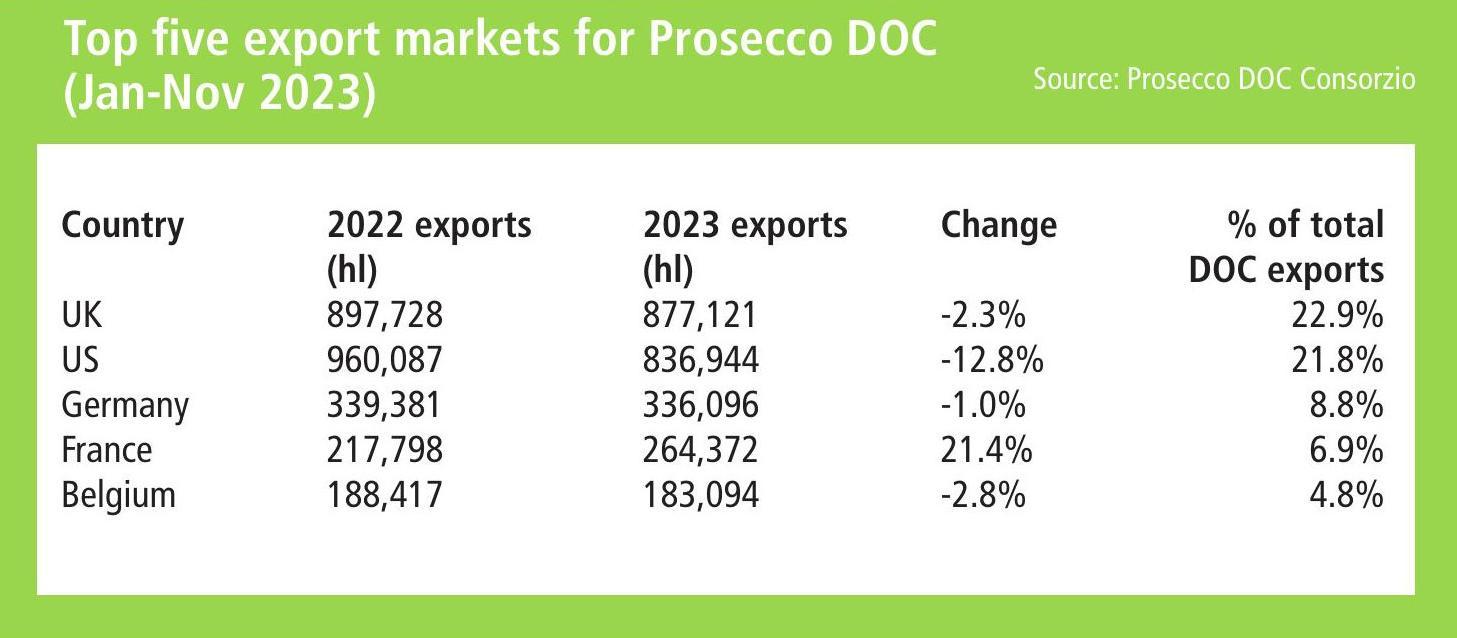
Exports, which account for just over 80% of total Prosecco DOC production, were even more stable – down by just 0.4% in the 11 months to November 2023. By comparison, Champagne shipments fell 8.2% last year, dipping below a symbolic 300m bottles. With a fall in US sales of Prosecco (see chart below), the UK is back in pole position among export markets, despite the volumes of Prosecco reaching UK shores dropping by 2.3%.
Robin Copestick, MD of Freixenet Copestick, dismisses talk of the UK market reaching ‘peak Prosecco’ any time soon, and says of the off-trade: “I know for a fact that Prosecco increased again in the UK last year.”
When it first appeared in the UK, “Prosecco was incredibly fashionable,” Copestick says. “Everybody was talking about it. Now it has become a staple, and I think it’s always going to be a very big part of the UK wine category for as long as one can see. There is nothing on the horizon that can challenge Prosecco’s base in the UK, nor its price point. I definitely don’t see it running out of steam in any shape or form.”
If not exactly hitting ‘a peak’ – which, after all, suggests a steep slide on the other side – it seems that Prosecco has reached a happy plateau. “Clearly volumes are finite – the category can’t grow exponentially,” says Copestick. “Supply and demand are in a fairly healthy place, so I don’t think that it’s in anybody’s interest to have a lot more vines planted.”
Paolo Lasagni agrees. “I’m happy with the current Prosecco planting area, and I’m in favour of the buffer, which is pretty big,” he says. ‘The buffer ’ being a reference to the pool of fermented Glera which the Consorzio can release to be made into Prosecco if required. Other tools in the Consorzio’s box to help manage supply include upping the permitted yield by 20% on the 150ql/ha limit in a good year, and setting the release date for each harvest. This year it fell on 1 January.
MINOR FLUCTUATIONS
“These are ways to absorb minor fluctuations,” says Pietro Mattioni, CEO of Zonin, one of Italy’s most important family-owned wineries. “But if volume demand continues to increase structurally, then you would need to have structural answers.”
If they come from anyone, these answers are likely to come from Stefano Zanette, president of the Prosecco DOC Consorzio.
“We are obliged to follow the growth in demand, and this is possible as long as there are vineyard areas that can be planted to match the rules on grape growing set out in the DOC,” he explains, adding that for now: “We are in a phase of wait and see, and of being prudent.”
The current limit, Zanette explains, is “very, very difficult to reach. So, what we’re trying to do at present is to maintain the balance of supply, where we already have around 600m bottles, and demand.”
His director at the Consorzio, Luca Giavi, says: “When we started, Prosecco was just one of many DOCs. Today, it’s the top denomination in Italy by volume and value, and clearly the complexities of managing something that important have grown. That was inevitable.”
Of course, you can argue that limiting supply while demand is growing will raise prices, but in Prosecco’s case, with such huge volumes, it might simply fuel speculation and substitution. In the domestic market, “generic sparkling wines gained quite a lot of market share when Prosecco increased its price last year”, says Lasagni, who is relieved that Bosco’s sales are around 70-75% export.
Striking a balance between elasticity of demand and setting a realistic, commercially sensible price can be tricky. When the UK’s top seller Freixenet increased its selling price by 5.5% last year, its sales slumped by 12%.
“We went in with our eyes open,” says Robin Copestick about the increase. “I think it’s important for us to have very strong brands that sell well.”
The price and volume provide enough margin to put Freixenet on TV, along with its stablemate I Heart Prosecco, which lies fourth in the UK’s Prosecco ranking charts.
BUILDING THE BRAND
Villa Sandi’s export director, Flavio Geretto, has been painstakingly building the brand and its stablemate La Gioiosa for years, and he believes all the hard work is starting to pay off.
“Last year we didn’t lose any listings even when we had to increase our pricing,” he says of the UK.
Behind the scenes there is constant activity on social media and through sponsorships, masterclasses and tastings. Among events planned, La Gioiosa will have a new TV campaign in Italy this Easter, and is sponsoring the best pizzeria in the world competition.
For Serena 1881 Prosecco, run by fifth-generation Luca Serena and his father Giorgio, the UK accounts for about 7% of exports, but thanks to a new distribution deal with Berkmann Wine Cellars, it hopes to reach 10% within two years.
At Perlino Prosecco, marketing director Elena Branda describes the overall market as “strong and stable”, and talks of developing a brut version for the European market, which will be a vintage expression. Thanks to being part of French group La Martinquaise, Perlino is number three in France – currently Prosecco’s fourth-biggest foreign market, and one of the fastest-growing. “France has been amazing for our Mionetto Prosecco,” says Robin Copestick.
After its meteoric rise, keeping the novelty and excitement swirling around Prosecco is a key challenge.
“There is always a risk of being part of a fashion wave, and all our activities are meant to keep that wave alive,” says Pietro Mattioni.
In his view, those who invest in consistent brand-building “can extract an extra dollar or euro, or even more, for each bottle. Otherwise, you play the game of commercial Prosecco, which is highvelocity and high promotions, and at a lower price. It is a different game”.
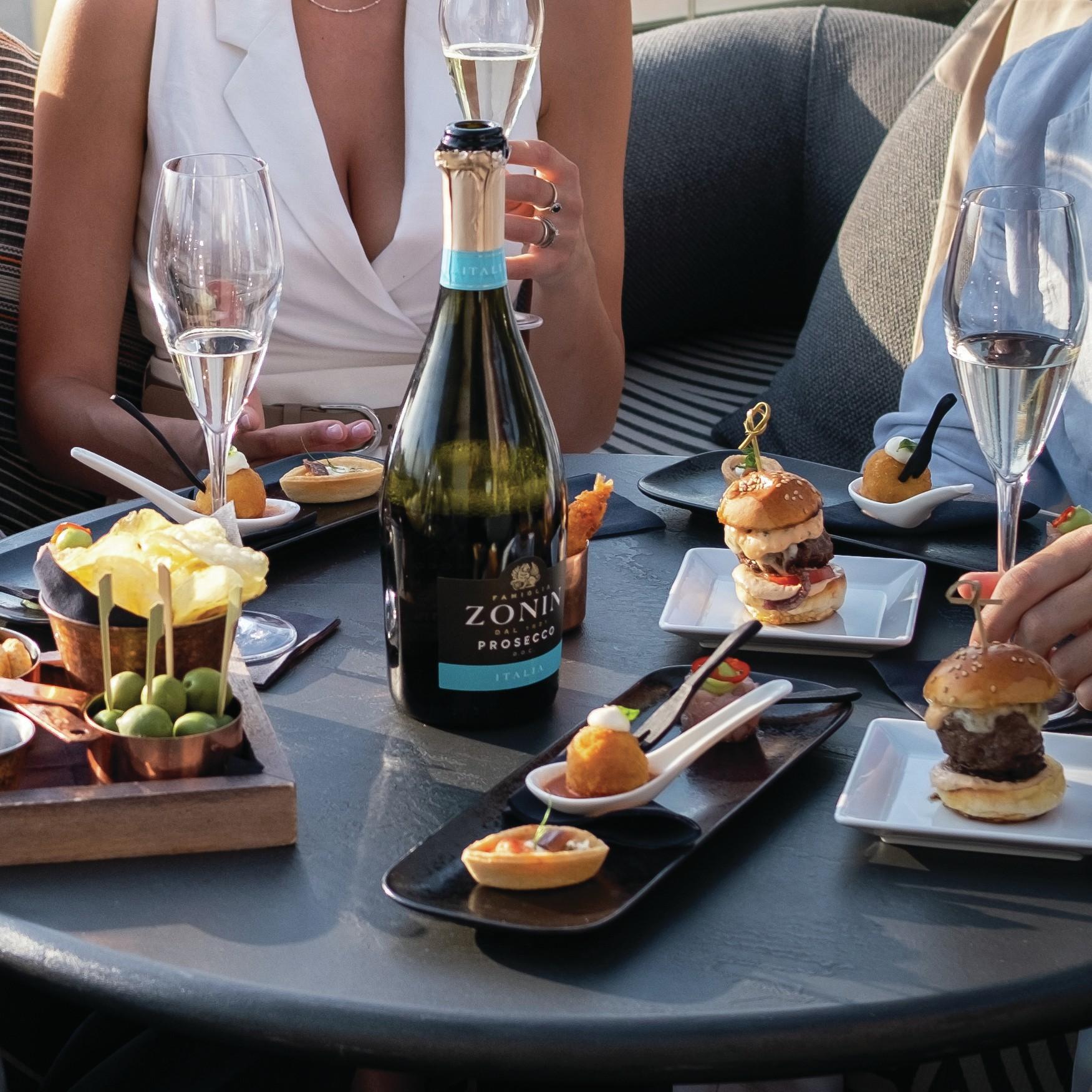
Zonin plays in both arenas, though it is more the latter in the UK and more of a branded approach in the US, its other key market. “Both our brands performed extremely well in the US in 2023,” Mattioni says. “Prosecco Zonin was up 12% and Castello del Poggio up 16%.”
Like many, he questions the industry’s ability “to explain to consumers abroad the difference between Valdobbiadene, Treviso, DOC and DOCG, because to them ‘Prosecco is Prosecco’. I think we have a very broad segmentation, and that’s not helping us to premiumise.”
DOUBLE-EDGED SWORD
Sarah Abbott MW knows this dilemma only too well, as founder and director of Swirl Wine Group, which has been working with Prosecco Superiore DOCG in the UK. “Even now there’s still so much education to do,” she says.
“Prosecco is a real double-edged sword. It has brought so much awareness to the region, increased land values and meant that young people can stay on the family farm. But, on the other hand, most UK consumers do not know what good Prosecco is really about.”
In her words, “youthful elegance is the soul of good Prosecco”, but getting that message across is not easy.
“The fact that it became so popular is one of the reasons why some members of the trade and the media don’t love it,” Abbott says, hinting at the distinct whiff of snobbery in some quarters around the world’s favourite fizz.
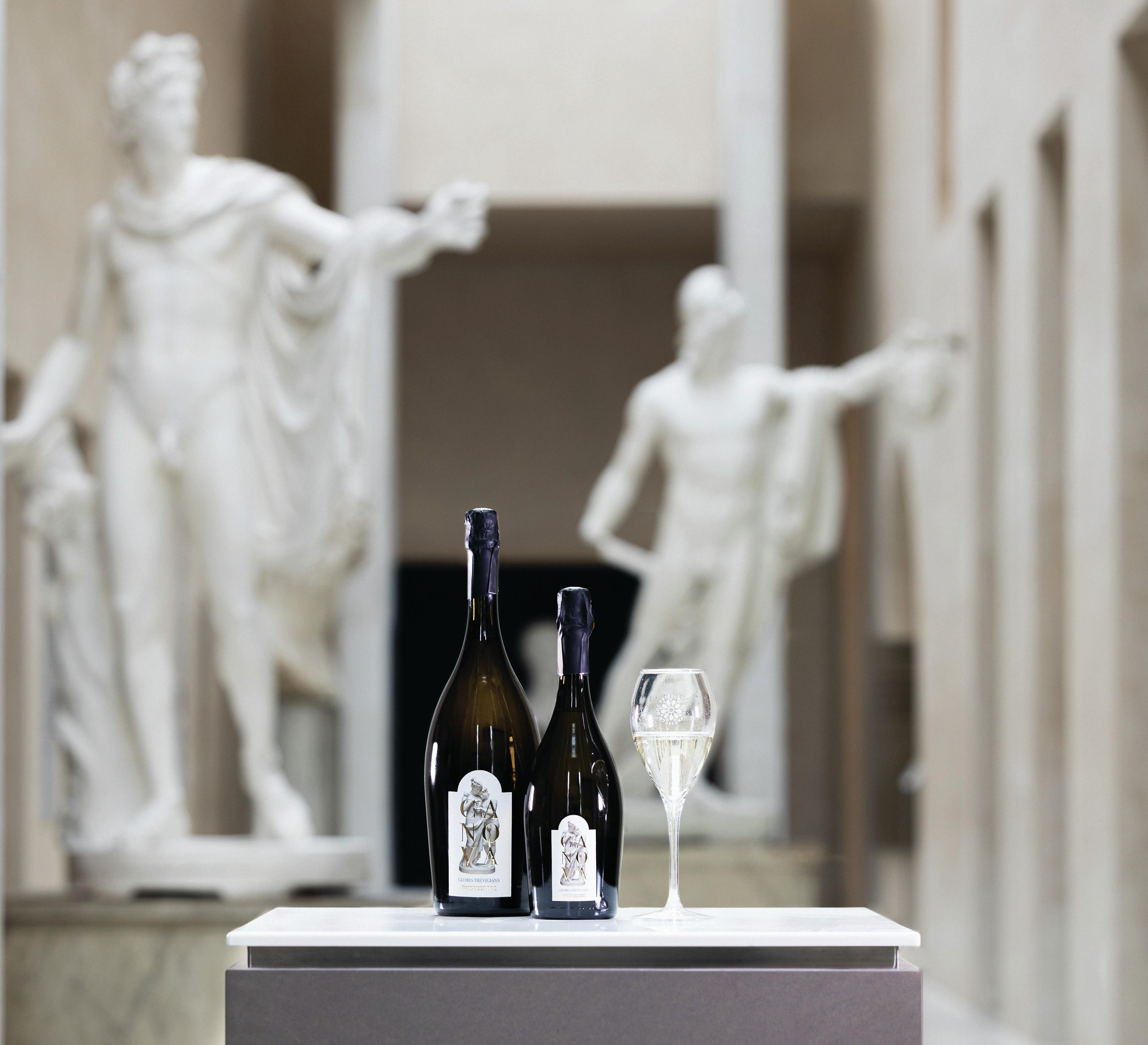
Last year, some 92.5m bottles of Prosecco Superiore were sold, 60% of them in Italy. Export volumes were down 6%, but grew 4.5% in value, which is a move in the right direction for the DOCG Consorzio’s president, Elvira Bortolomiol.
“It is clear [that] the gap between the DOC and the DOCG is not yet satisfactory,” she says. “The labour involved on the hills means it costs three times more per hectare than on the plain, and clearly this is not reflected in the price.”
There are efforts to promote the more premium level of Prosecco DOCG from selected sites known as ‘rive’, but the numbers are quite small, with only 3m bottles sold last year.
The most recent figures available, from 2022, position the UK as the top importer of Prosecco DOCG on 10.3m bottles, followed by Germany and Switzerland. The US imported 3m bottles that year, representing 7% of total DOCG shipments, compared to 21.8% of Prosecco DOC exports, suggesting a real opportunity for ‘Superiore’ in the US.
Bortolomiol agrees, and says: “We are searching for our position within this market, especially in terms of value – that’s our key challenge.”
Abbott is confident that ‘Superiore’ has the necessary quality, and says: “These are subtle, delicate, breezy wines where you can get beautiful texture and a lovely flavourful acidity.”
As for positioning, she reckons: “They could learn a lot of lessons from the development of the UK market.”
In her view, Aldi’s smartly-packaged Prosecco Superiore, at only £7.49, should be seen as “an incredible price-fighting bargain”, much like its entry-level Champagne. If it isn’t, she says, “it is because the category hasn’t yet landed its quality credentials”.
PANORAMIC VIEW
Matteo Lunelli, whose company Ferrari acquired the top-rated Prosecco Superiore Bisol in 2014, says: “In general, it is not easy to position a Prosecco brand at the high end of the sparkling wine market, because unfortunately it is often considered a commodity, and sometimes consumers do not fully perceive the work being done in the vineyards in order to produce excellent Prosecco.”
To help with this, Bisol has just installed a live webcam that displays a panoramic view of “the heroic hills of Valdobbiadene and shows the whole world the beauty of this land”, says Lunelli.
Meanwhile, Flavio Geretto has also been focusing on the smaller, but growing, Prosecco DOCG area of Asolo, where Villa Sandi is the top-selling brand, and now available in 51 markets.
As for repositioning Prosecco at a higher level, he says: “In my opinion, what makes for value are the wineries, and the families and stories behind them.” Throw in a few ‘heroic hills’ and you have something to build on – something that might just allow that teenager we met at the start to truly come of age.
Related news
Why electrolytes have become wine's newest additive
Bordeaux marks milestones with commemorative bottles
#WeekInPictures: the Queen visits Plumpton as craft beer and rum move into new territory


