



Uruguay declares wine a living culture in landmark policy move
Uruguay has formally recognised wine as a ‘living culture’ through a cross-government initiative designed to integrate cultural policy, industry strategy and international diplomacy. The programme aims to redefine the country’s wine sector as a broader expression of heritage, identity and community.
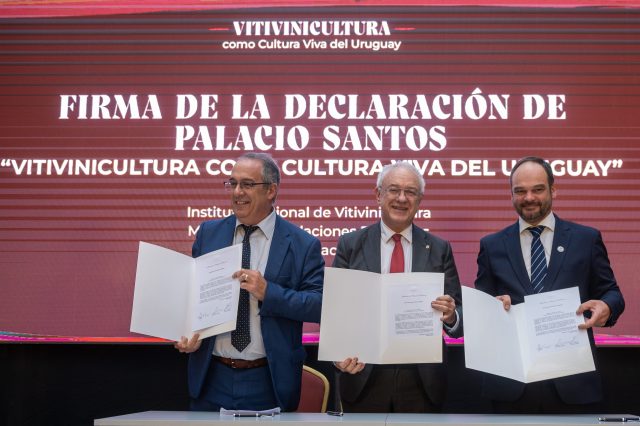
In an unprecedented cross-government initiative, Uruguay has declared wine a ‘living culture’ through a formal declaration signed at Palacio Santos in Montevideo last week.
While several countries have successfully positioned wine as cultural heritage, notably through UNESCO recognition, these efforts have largely focused on preservation. Uruguay’s approach is more explicitly programmatic, combining cultural policy, sector coordination and international diplomacy within a single initiative.
Cross-government agreement signed
The agreement was signed on 22 April between the Ministry of Foreign Affairs, the Ministry of Education and Culture, and the country’s wine body, the Instituto Nacional de Vitivinicultura (INAVI). The programme, Vitivinicultura como Cultura Viva del Uruguay, seeks to expand the perception of the sector beyond production and exports, framing it instead as a broader cultural system encompassing heritage, landscape, community and identity.
The official ceremony saw 200 members of the diplomatic corps, government officials and institutional representatives witness the signing of the Declaración de Palacio Santos, a formal statement of intent to develop a long-term, cross-institutional agenda.
Cultural diplomacy and international ambition
“We want to project this agenda internationally through cultural diplomacy and the exchange of best practices, positioning Uruguay as a reference case in this field,” INAVI president Diego Spinoglio told The Drinks Business. “But this programme can only truly grow if it is a shared construction, with cultural legitimacy, territorial roots and institutional collaboration.”
INAVI will act as a technical and sectoral coordinator, working closely with wineries, growers and local communities to ensure the programme is grounded in the realities of the industry.
Partner Content


International support for the initiative
The initiative has also drawn support from the International Organisation of Vine and Wine. Its director general, John Barker, said: “Uruguay is a long-standing and highly valued member of the OIV family and I am delighted to see this high-level commitment to promoting the wine culture of this beautiful and historic wine country. I hope that the OIV’s own work on cultural heritage can contribute to this initiative, and that in turn the OIV can learn from Uruguay’s success.”
The initiative forms part of a wider strategic shift under INAVI’s new leadership, which is also encouraging a significant reconversion of Uruguay’s vineyards. The organisation is offering incentives for growers to replace high-yielding, volume-driven varieties, including Moscatel de Hamburgo and Ugni Blanc, with fine wine grapes such as Tannat and Albariño.

According to INAVI’s vice president, Nicolas Monforte, the programme could see around 1,000 hectares, close to a fifth of the country’s vineyard area, replanted over the next five years. This will be the biggest conversion period for Uruguay’s vineyards since the 1990s.
“Our goal is for wineries to be less reliant on producing table wine for the domestic market, and instead focus on fine wines for export,” Nicolas told The Drinks Business. “We are supporting this through technical guidance in vineyard conversion and investment in winery innovation.”
Supporting small producers and heritage
More than 70% of Uruguay’s vineyards are under 10 hectares and family-run. These initiatives form part of a longer-term strategy to improve financial sustainability across the sector, while preserving the cultural heritage that the new programme seeks to highlight.
Amanda Barnes MW is the drinks business’ regular South America correspondent and author of The South America Wine Guide.
Related news
Herti expands business in South America
Michelin Guide announces first-ever American South selection


